TRADE POLICY DAY AT BIA – AN EVENT HIGHLIGHTING THE OPPORTUNITIES EU TRADE AGREEMENTS OFFER TO BUSINESSES
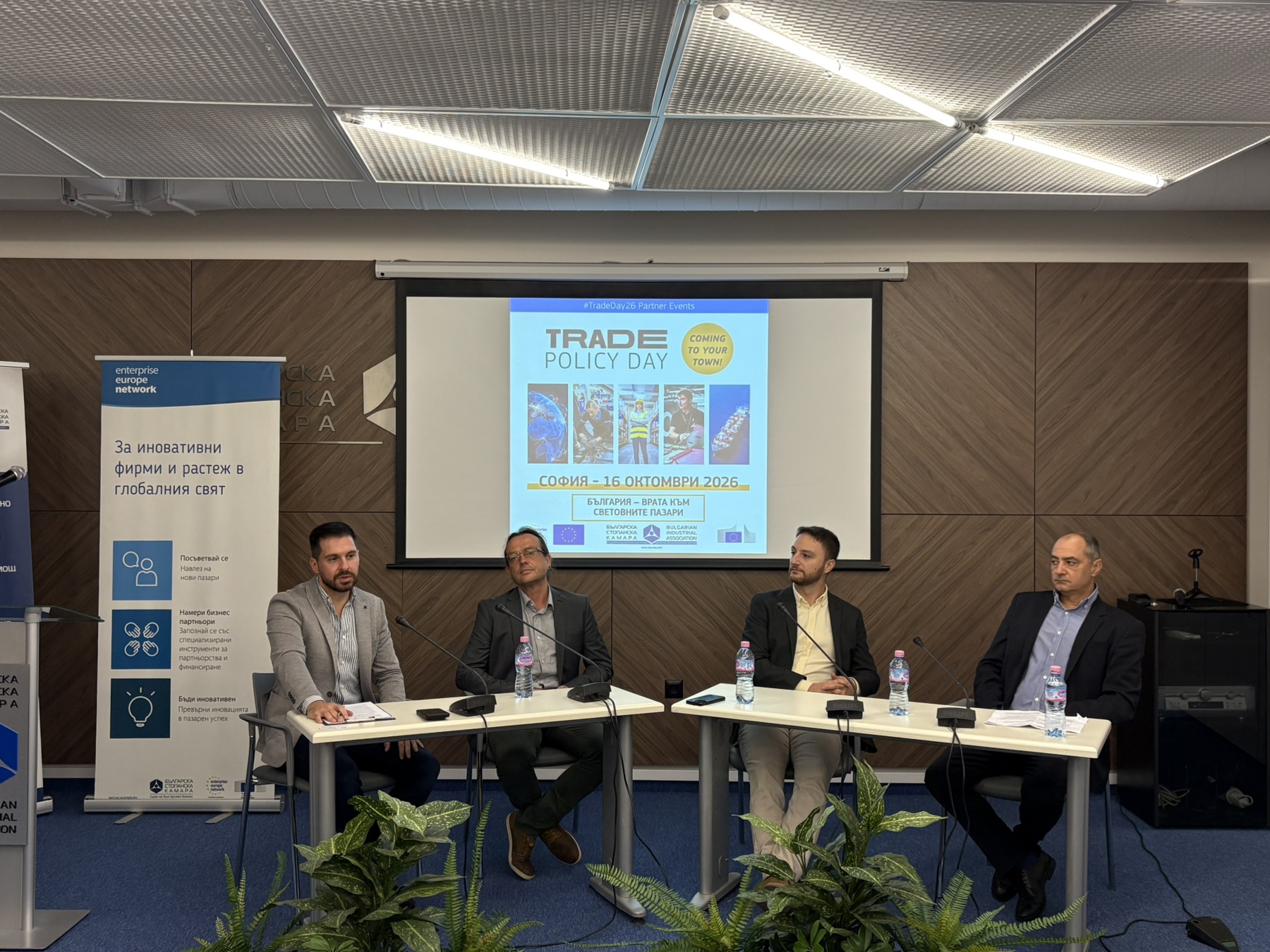
On 16 October 2026, the Bulgarian Industrial Association (BIA) hosted an event as part of European Trade Policy Day, dedicated to the opportunities offered by the European Union’s free trade agreements to small and medium-sized enterprises (SMEs), as well as the challenges companies face when trading with non-EU countries. The discussions also addressed the impact of the EU regulations and frameworks on the Carbon Border Adjustment Mechanism (CBAM), the Digital Product Passport (DPP) and the EU Deforestation Regulation (EUDR) on international trade and business operations.
The event was organised jointly with the European Commission’s Directorate-General for Trade (DG TRADE), the Representation of the European Commission in Bulgaria and the Enterprise Europe Network.
Trade agreements – untapped potential for businesses
The event was opened by Maria Mincheva, Vice President of the Bulgarian Industrial Association, who emphasised the need for companies to gain a better understanding of the opportunities offered by EU trade agreements.
“This is a major gap and untapped potential for every country, including our own,” Mincheva noted. According to her, Bulgarian companies often benefit indirectly from these agreements through their participation in the supply chains of large European enterprises, without having a sufficiently clear understanding of the specific terms and opportunities available to them.
She described the initiative as timely and highlighted the importance of the network of trade ambassadors across EU Member States, who work to communicate trade policy and the benefits of trade agreements in a way that is accessible and relevant to businesses.
Yordanka Chobanova, Head of the European Commission Representation in Bulgaria, also stressed the importance of trade agreements in expanding market opportunities for European businesses. She noted that, as Bulgaria approaches the 20th anniversary of its EU membership, Bulgarian businesses are already part of the EU Single Market, while the Union’s agreements with non-EU countries open up additional opportunities for growth.
“Europe is choosing to be independent, and to be independent, we need to diversify. We need more partners, more reliable partners, more markets and more opportunities,” Chobanova said.
She pointed out that trade agreements can provide access to new customers, lower tariffs and fewer administrative barriers. However, their success ultimately depends on whether companies are able to take practical advantage of these benefits. It is therefore important for institutions to listen to businesses and understand the obstacles faced by companies that create jobs and contribute to the competitiveness of the economy.
In a video address, Maroš Šefčovič, European Commissioner for Trade and Economic Security, Interinstitutional Relations and Transparency, highlighted the role of the network of trade ambassadors in explaining and promoting EU trade policy. He stressed that the EU is a leading global trading power, accounting for approximately 16% of global trade in goods and services.
Šefčovič also outlined the broader context of EU trade policy, including efforts to conclude new trade agreements, the management of relations with key partners such as the United States and China, the diversification of trade relationships and the reform of the World Trade Organization (WTO). He also emphasised the importance of trade defence instruments through which the EU supports European businesses in a changing international environment.
How SMEs can benefit rom trade agreements
During the first panel, Sofia Muñoz Albarán, Director for Interinstitutional Affairs, Information Outreach, Communication and Resources at the European Commission’s Directorate-General for Trade (DG TRADE), presented the opportunities that EU free trade agreements offer businesses.
She highlighted progress in negotiations and the development of trade relations with partners such as Mercosur, Indonesia, India, Mexico, Australia and the Philippines. According to her, the benefits of these agreements extend to both trade in goods and trade in services. As an example of their practical impact, she cited opportunities to enter new markets, including exports of EU wine to Canada, as well as the elimination of high tariffs in a number of sectors.
During the event, Emil Dandalov, a member of the Management Board of the National Organisation of Customs Agents in Bulgaria and of the Management Board of the Bulgarian Industrial Association, pointed out that the availability of preferential trading conditions does not automatically guarantee that businesses will be able to benefit from them. To take advantage of lower tariffs, companies must understand the applicable rules, prove the origin of their goods, and account for the administrative costs and time required to comply with the relevant procedures.
“If the additional costs exceed the tariff savings, there is no financial reason to use the preference,” Dandalov emphasised. He noted that assessing the effectiveness of trade agreements requires consideration not only of the opportunities they create, but also of the extent to which businesses actually use them.
As an example of untapped potential, he cited data from a European Parliament report indicating that only 3% of the tariff-rate quota for Canadian beef and veal was used in 2021. Dandalov clarified that these figures refer to 2021 and do not necessarily reflect the current situation, nor do they imply that the CETA agreement as a whole is underutilised. In his view, such cases demonstrate the need to analyse the reasons behind low utilisation of individual quotas, including prices, transport costs and the requirements of the EU market.
He also provided practical examples of difficulties in customs procedures that can lead to delays and additional costs for companies. These include waiting for information and confirmations from customs authorities, funds being tied up, and disputes over the application of certain procedures. According to Dandalov, better coordination between administrations, the exchange of information before goods arrive and clearer response deadlines would make trade more predictable.
Dandalov also addressed the challenges SMEs face in relation to CBAM and EUDR. He noted that access to reliable information throughout the supply chain is a key issue, particularly when data must be provided by other companies. Under the EUDR, for example, importers of certain wood products must have information on the origin of the timber and the legality of its harvesting, making it essential to prepare before the goods are dispatched.
New EU requirements and their impact on budinesses
The second panel, moderated by Denislav Borisov from EY Bulgaria’s Brand, Marketing & Communications team, focused on the relationship between trade agreements and EU regulations concerning sustainability and product traceability.
Ivan Paspaljiev, Senior Manager at EY denkstatt, introduced the topic of the Digital Product Passport (DPP). He explained that digital access to product information, for example via a QR code, will enable consumers and other supply chain stakeholders to obtain information about product characteristics, materials used, recycled content and carbon footprint.
The requirements will cover various product groups and affect not only European manufacturers but also importers. Sectors expected to be significantly affected include furniture and textiles, as well as battery and construction products manufacturing. The introduction of product passports will also require information to be maintained throughout the product lifecycle.
Eng. Petar Dishkov, an expert at the Branch Chamber of the Woodworking and Furniture Industry (BCWFI), highlighted the challenges facing the furniture sector in implementing the EU Deforestation Regulation (EUDR). He noted that the sector includes many SMEs for which meeting all the requirements could create a significant administrative and organisational burden.
Dishkov stressed that sustainable forest management is essential for the sector, but that the effectiveness of the Regulation will also depend on how imports from non-EU countries are monitored. In his view, the rules must be implemented in a way that ensures traceability and compliance without creating disproportionate difficulties for businesses that operate responsibly and comply with the requirements.
Yavor Vasilev, Director of EmiCert, an accredited independent verification body covering all sectors under CBAM, outlined the main challenges companies face in implementing the Carbon Border Adjustment Mechanism. He highlighted the limited awareness among some importers and the need for companies to obtain reliable data on the actual emissions of producers, which are subject to verification.
Vasilev noted that companies must monitor current regulatory requirements and, where necessary, seek support from qualified consultants. He also observed that CBAM is attracting increasing attention beyond the EU, where similar measures and requirements are beginning to emerge.
The discussions demonstrated that EU trade agreements create significant opportunities for market expansion. However, taking practical advantage of these opportunities requires a sound understanding of the rules, predictable administrative procedures and readiness to comply with increasingly demanding regulatory requirements. For SMEs in particular, access to clear information and expert support is essential to turning these opportunities into tangible business benefits.