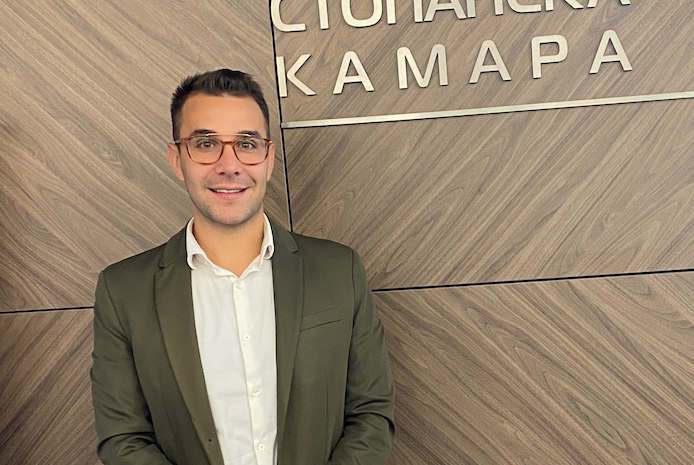
TOMISLAV TOSHKOV: MEDIATION HELPS DISPUTING PARTIES PRESERVE THEIR BUSINESS RELATIONSHIPS
Tomislav Toshkov graduated with distinction in Law from the Faculty of Law of Sofia University “St. Kliment Ohridski” (2014–2019) and has been a legal professional since 2020. In 2021, he successfully passed the bar admission examination before the Supreme Bar Council, pursuant to Article 4, paragraph 1, item 4 of the Bulgarian Bar Act.
He has completed numerous training courses and specializations in human rights protection and refugee law, including under the European Commission’s Erasmus+ youth mobility programme in Milan (Italy), Vienna (Austria), and Bristol (United Kingdom).
Since 2016, he has worked at the “Krastyu Tsontchev” Lawyers’ Training Centre of the Supreme Bar Council. In 2022, he was elected by the Centre’s Board of Directors to serve as its Secretary General. His main responsibilities in this capacity involve organizing and conducting training aimed at maintaining and enhancing the professional qualifications of Bulgarian lawyers, pursuant to Article 27 et seq. of the Bulgarian Bar Act. In this capacity, he actively works and cooperates with the governing bodies of the Bulgarian Bar, bar associations throughout the country, as well as other state institutions, courts, and non-governmental organizations.
In 2021, he was selected as the representative (Info Point) of the Council of Europe’s European Programme for Human Rights Education for Legal Professionals (HELP) for the Bulgarian Bar, and since July 2021 he has also served as a member of the Programme’s Consultative Board with an advisory vote. To date, more than 12 adapted courses have been delivered in Bulgarian, with the participation of over 300 Bulgarian lawyers.
He is a certified HELP trainer and conducts training for Bulgarian lawyers on topics related to the protection of human rights. He also serves as an external expert to the Council of Europe.
Since 2022, he has been appointed by the Supreme Bar Council as its representative and a member of the Consultative Board of the European Lawyers Foundation (ELF), whose main mission is to promote access to justice by providing high-quality training for lawyers, as well as by supporting activities related to the legal profession, the rule of law, significant developments in legal systems, human rights protection, and international justice.
In his legal practice, he has advised individuals and legal entities, as well as local government authorities and representatives.
In 2017, he completed a course leading to qualification as a mediator at the “Krastyu Tsontchev” Lawyers’ Training Centre. In October 2022, he was officially registered in the Unified Register of Mediators maintained by the Ministry of Justice of the Republic of Bulgaria. Since 2022, he has been a lecturer in mediation (general and commercial mediation) at the Bulgarian Association for Mediation (BAM), and since June 2023 he has been registered in the Register of Mediators maintained by the Centre for Settlement and Mediation at the Sofia District Court and the Sofia City Court.
Since September 2023, he has been included in the list of mediators of the Arbitration Division of the Arbitration Court at the Bulgarian Industrial Association.
What attracted you to mediation?
Following the development of legal systems both in Bulgaria and around the world, I realized that people are increasingly turning to alternative methods of dispute resolution. Mediation empowers the parties themselves to decide whether they want to resolve their dispute and what the final outcome should be.
The very principles of mediation – voluntariness, confidentiality, equality, and the neutrality and impartiality of the mediator, give the parties the peace of mind to assess their interests wisely and objectively and to find the most beneficial solution to the dispute between them.
It was precisely this freedom that attracted me to mediation: the opportunity to look at a conflict from a different perspective and to help the parties explore not only legal but also non-legal issues, which tend to receive little attention in the courtroom.
Mediation is a deeply humane and autonomous activity, and every mediator’s mission is to promote it among the public by providing a realistic and accurate understanding of how it works.
What are the most common challenges in mediation proceedings?
I can identify two turning points in a mediation process: the moment when you earn the parties’ trust and the moment when you bring their interests to the negotiating table.
Once you are able to skillfully apply mediation techniques, conduct the procedure in accordance with the law and follow its established framework, ask the right questions, and help the parties communicate with one another, you will certainly succeed in gaining their trust and bringing their underlying interests to the surface.
This, in turn, greatly facilitates the achievement of a reasonable and mutually acceptable settlement.
When does the resolution of a dispute bring satisfaction to the parties and to you as a mediator?
The focus in mediation should not be placed solely on reaching an agreement and finding a solution to the situation that has arisen.
On the contrary, the very fact that the parties have improved their relationship, have started communicating with one another, and are willing to reach an agreement is already a small victory both for them and for the mediator.
Of course, when they voluntarily accept a settlement without external intervention and solely with the assistance of the mediator, this is a strong indication that they will comply with it in good faith going forward.
This brings great satisfaction to every mediator.
What advice would you give to companies facing unresolved commercial disputes?
My advice is that, before turning to the courts, they should consider the fact that they have another option – one that is much easier and much faster. An option that takes their interests into account.
That option is mediation.
Through mediation, they have the opportunity to preserve their long-standing business relationships, keep their disputes confidential, and ensure that any agreement they reach is based solely on their own assessments and decisions.