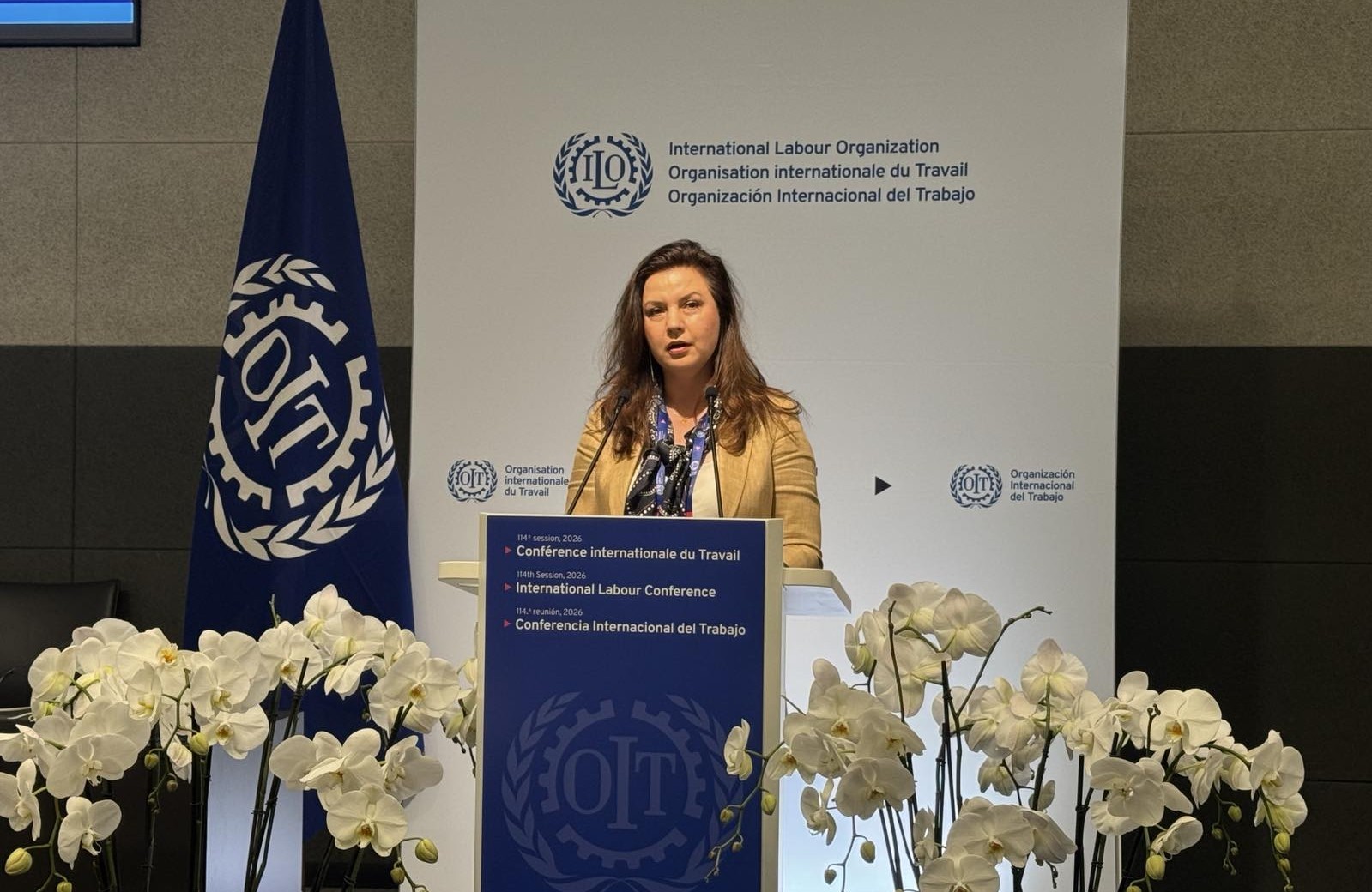
The representative of the AOBR made a statement to the delegates at the 114th session of the ILC
"Artificial intelligence (AI) has enormous potential. It can increase productivity, support innovation, improve working conditions and help enterprises cope with the growing shortage of labor. At the same time, we must approach this transformation in a balanced and pragmatic way."
This was said today (03.06.2026) by the Vice President of BIA, Mariya Mincheva, to the delegates at the 114th session of the International Labor Conference (ILC), which is taking place from 1-12 June in Geneva, Switzerland. Maria Mincheva is a delegate of the Association Association of the Organizations of Bulgarian Employers (AOBE), the deputy delegate is Tsvetan Simeonov – President of the Bulgarian Chamber of Commerce and Industry (BCCI), and the advisor is Jasmina Sarivanova – Director of Industrial Relations at the BIA.
The theme of this year’s report – “Using Artificial Intelligence to Support Decent Work” – is extremely relevant, as AI is already transforming labor markets, enterprises and the organization of labor around the world. According to Maria Mincheva, technological progress should not be viewed solely through the prism of risks – “History shows that innovations not only replace certain tasks, but also create new opportunities, new professions and new forms of economic activity. Therefore, the main challenge is how we manage this transition.”
According to the Bulgarian employers' representative, "We must ensure that the digital transformation does not deepen inequalities between countries, companies or workers. Artificial intelligence should not divide us, it should be a tool for stronger economies, better jobs and sustainable growth."
***
See PHOTOS
Here is the full statement by Maria Mincheva:
Distinguished Chairperson,
Distinguished delegates,
Ladies and gentlemen,
The topic of this year’s report – “Harnessing artificial intelligence for decent work” – is highly relevant, as artificial intelligence is already transforming labour markets, enterprises and the organisation of work around the world.
Artificial intelligence has enormous potential. It can increase productivity, support innovation, improve working conditions and help enterprises address growing labour shortages.
At the same time, we must approach this transformation in a balanced and pragmatic way.
Technological progress should not be viewed only through the lens of risks. History shows that innovation not only replaces certain tasks, but also creates new opportunities, new professions and new forms of economic activity. Therefore, the key challenge is how we manage this transition.
For Bulgaria, this debate is particularly important.
Our economy is facing serious structural labour market challenges: labour shortages, demographic decline, an ageing population and significant mismatches between education systems and labour market needs. At the same time, the formation of a government supported by a parliamentary majority creates an opportunity for the gradual addressing of these challenges. Combined with relatively solid macroeconomic indicators and the successful introduction of the euro as the national currency, Bulgaria remains an attractive destination for investment.
In this context, artificial intelligence can become part of the solution – by supporting workers, increasing productivity and helping enterprises create higher added value.
Investments in digital skills, lifelong learning, vocational education and re-skilling are strongly supported by employers in Bulgaria. Education systems must adapt more rapidly to the real needs of the economy and technological change.
At the same time, labour market policies must remain economically sustainable and aligned with productivity developments.
In Bulgaria, the minimum wage continues to be determined administratively by the Council of Ministers, without a clear mechanism as required under ILO Convention No. 131, effectively excluding the social partners from the process of its determination. In recent years, this has resulted in wage growth rates that, in many cases, outpace labour productivity and economic realities across sectors and regions.
Income policies should be predictable, economically justified and developed through effective social dialogue and in line with Bulgaria’s international commitments.
Especially in the current economic environment, enterprises need conditions that support investment, innovation and competitiveness.
At the same time, we should not only avoid overly complex, fragmented or disproportionate regulatory frameworks that slow down innovation, but also remove unnecessary existing regulatory burdens.
Regulation should provide clarity and trust, while preserving competitiveness and the ability of enterprises to adapt and invest.
Employers in Bulgaria believe that social dialogue has an important role to play in this process.
The involvement of employers and workers can help build trust, improve the implementation of new technologies and ensure that policies reflect labour market realities.
Finally, we must ensure that digital transformation does not deepen inequalities between countries, enterprises or workers.
Artificial intelligence should not become a source of new divisions, but rather an instrument for stronger economies, better jobs and sustainable growth.
Thank you for your attention.