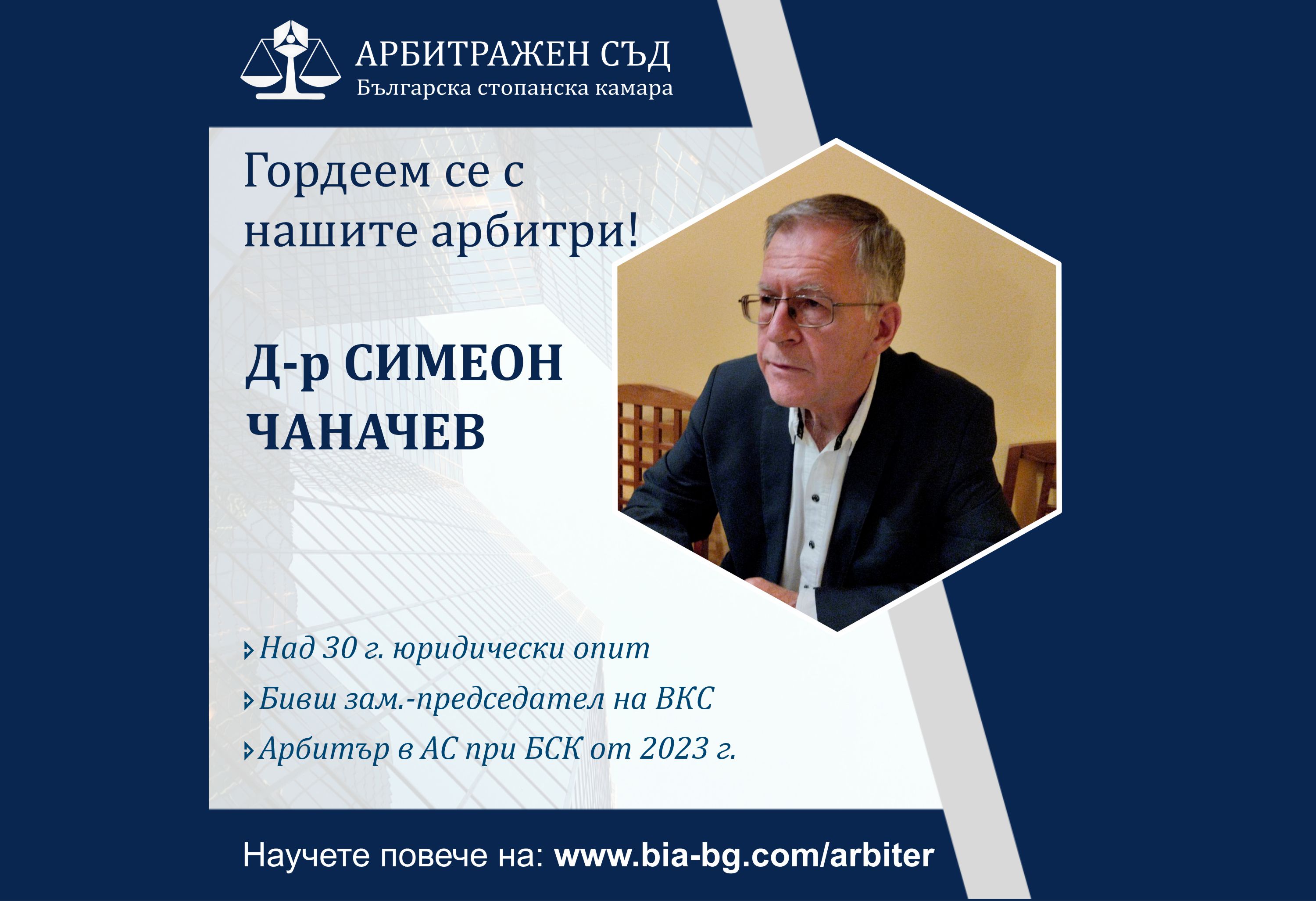
The Arbitration Court at the Bulgarian Industrial Association is proud of its arbitrators! Today, we present Dr. Simeon Chanachev.
Dr. Simeon Chanachev graduated in Law from Sofia University “St. Kliment Ohridski”, after which he successively served as a junior judge at the Sofia City Court, a district judge at the Sofia District Court, Deputy Chair of the Third District Court in Sofia, a judge at the Sofia City Court, and a judge at the Supreme Court and the Supreme Court of Cassation. From 2007 to 2012, he served as Deputy Chair of the Supreme Court of Cassation. He holds a PhD in Law. His professional career has focused on civil law and civil procedural law.
Since 2023, he has served as an arbitrator at the Arbitration Court at the Bulgarian Industrial Association.
What attracted you to arbitration?
It provides for the independent resolution of legal disputes through adversarial proceedings conducted by an arbitral tribunal constituted by arbitrators designated by the parties, based on the trust that those same parties have placed in the professionals selected to serve as arbitrators.
These fundamental characteristics of arbitration are, on the one hand, advantages for the parties and, on the other, an opportunity for the arbitrator to apply the professional experience they have accumulated.
What are the most common challenges in arbitration proceedings?
As with any form of adjudication, the main challenges in arbitration proceedings are related to clarifying the actual relationship between the parties to the dispute, as well as interpreting and applying substantive and procedural law in light of the specific circumstances of each case.
When does the resolution of a dispute bring satisfaction to the parties and to you as an arbitrator?
I believe that the resolution of a dispute brings satisfaction to both the parties and the arbitrator when the trust placed by the parties – expressed through their choice of the arbitrator they have designated to serve as a member of the tribunal – is justified by the legal outcome reached by the tribunal.
In such a case, the arbitral tribunal’s decision, which establishes what the tribunal considers to be the actual legal position in the dispute and what the parties’ definitive legal conduct should be in their future relationship, must be sufficiently reasoned and consistent with the law in order to be perceived as a fair resolution of the legal dispute that has arisen.
What advice would you give to companies that have unresolved commercial disputes?
Modern business relationships are characterized by the dynamic nature of legal relations arising from rapidly developing, and sometimes economically unexpected, events and consequences that may not always follow formal logic.
Therefore, the careful and competent conduct of pre-contractual negotiations is of considerable importance in preventing commercial disputes and avoiding the emergence of unresolved business relationships that may subsequently require intervention by the state courts or voluntary adjudication through arbitration.
Equally important is the detailed and comprehensive drafting of the relevant legal transactions through clear contractual clauses that fully and exhaustively regulate the subject matter of the parties’ relationship.
In my experience as a judge, I have observed that a large proportion of legal disputes result from the incomplete or inaccurate recording of the agreements reached between contracting parties concerning the essential terms of their transactions.
This has required, when resolving legal disputes, the use of means to establish the parties’ true intention pursuant to Article 20 of the Bulgarian Obligations and Contracts Act.
In conclusion, the solution to the problem of “unresolved commercial disputes” should be sought in conducting a precise and competent negotiation process, both during the pre-contractual stage and when concluding the legal transaction.
Last but not least, it is essential to ensure that the parties’ actual intentions, as embodied in the contractual provisions, are properly reflected in the performance of their respective obligations.