BIA INDEX 2025: BULGARIA HAS POTENTIAL, BUT REFORMS CANNOT WAIT
The Bulgarian Industrial Association presents, for the third consecutive year, its annual report the "BIA Index 2025", which measures the effectiveness of economic policy across European Union Member States through a system of internationally comparable indicators.
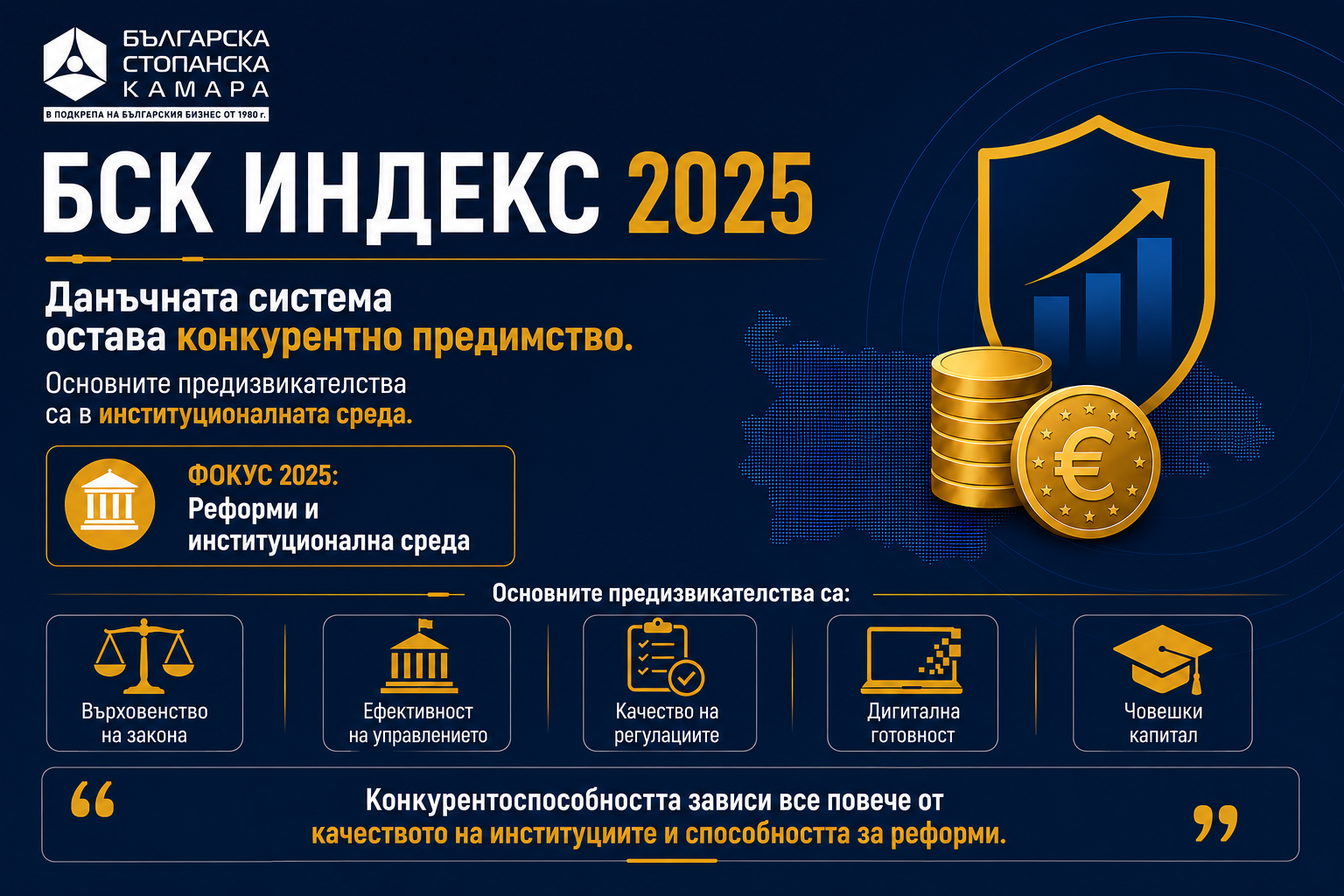
The index tracks the development of Bulgaria in three key areas – "Investments and Innovation", "Reforms and Institutional Environment" and "Fiscal Policy Effectiveness". This year's edition focuses on the "Reforms and Institutional Environment" pillar, analysing the factors that determine the economy's ability to attract investment, increase productivity, and achieve sustainable growth.
The results show that Bulgaria continues to possess significant competitive advantages. The country is among the EU leaders in tax competitiveness, ranking first for its effective average tax rate and second for its corporate tax rate. Furthermore, Bulgaria retains the distinct advantages of European Union membership, including access to the European single market and a strategic geographical location.
However, the analysis also demonstrates that Bulgaria's competitiveness increasingly depends on the quality of its institutions, the effectiveness of public governance, the regulatory environment, human capital, and the capacity to implement consistent reforms.
Bulgaria's overall score on the BIA Index 2025 is 29.98 points , placing the country 27th among European Union member states. Under the "Reforms and Institutional Environment" pillar—the focus of this year's edition—Bulgaria receives 31.10 points, occupying 25th place in the EU. The most severe lag within this pillar is observed in indicators relating to the rule of law, government efficiency, and digital readiness for the future.
The main structural challenges facing the Bulgarian economy include:
- insufficient institutional effectiveness;
- weak digital readiness within the public sector;
- unfavourable demographic trends;
- a shortage of skilled labour;
- limited links between education, science, and business;
- the slow implementation of innovations and new technologies.
As a member of the European Union, Bulgaria has significant opportunities to accelerate economic development through access to the single market, European investment instruments, and the Union's technological initiatives. However, nearly two decades after joining the EU, the country continues to lag behind in terms of labour productivity, innovation capacity, digital readiness, and the quality of public governance.
Intensifying geo-economic competition, the green and digital transitions, the deployment of artificial intelligence, and shifts in global value chains place new demands on countries' ability to increase productivity, technological capacity, and institutional efficiency. In this context, sustainable economic growth is becoming less dependent on isolated competitive advantages and increasingly reliant on the quality of public policies and the ability to implement reforms.
The analysis of the "Reforms and Institutional Environment" pillar highlights that the primary constraints on Bulgaria's competitiveness relate to the quality of institutions, the effectiveness of public governance, the regulatory environment, digital readiness, and human capital development. Although the country retains several competitive advantages, including high tax competitiveness, lagging behind in these structural indicators limits its ability to translate these benefits into higher productivity, investment, and sustainable economic growth.
Based on Bulgaria's performance across these indicators, the BIA has formulated five key priorities for economic policy. These aim to improve the country's performance in areas where it lags furthest behind the rest of the EU, mitigating structural weaknesses in the institutional environment, accelerating economic convergence, and boosting competitiveness:
- Improving institutional efficiency – rule of law, quality of regulations, and administrative capacity;
- Human capital development – STEM education, workforce qualification, and closer links between education and business;
- Promoting innovation and technological transformation – innovation capacity, adoption of new technologies, and investments in research and development;
- Improving the investment environment – predictability, transparency, and reducing the administrative burden;
- Accelerating digital transformation – digitalisation of public services and the development of e-government.
According to the BIA, Bulgaria possesses the necessary prerequisites to accelerate its economic development and improve its standing within the European Union. Tax competitiveness, a strategic location, and access to the European single market create a strong foundation for growth. However, to fully exploit these advantages, they must be complemented by more efficient institutions, higher-quality public governance, human capital development, and accelerated technological transformation.
The potential is there. The challenge now is to translate it into higher productivity, increased investment and sustainable economic growth.
______________________
Read the full "BIA Index 2025" in Bulgarian here
View the executive summary in English and Bulgarian here
View the infographics (in Bulgarian) here
Access all reports (in Bulgarian) here here