WILL THERE BE A NEW MECHANISM FOR DETERMINING THE MINIMUM WAGE?
The state, business and trade unions have less than two months to agree on a new mechanism for determining the minimum wage. If they fail to do so, it will be difficult to increase it. What should the new mechanism look like?
Petar Nikov from Ruse works as a security guard and earns the minimum wage. He saves money on clothes and estimates that he needs at least €900 a month to live a normal life.
Petar Nikov, security guard: “Don’t ask me how much money I have left after I pay the electricity, water and other bills. There’s barely anything left—just enough to go out for coffee three or four times a month.”
Since 2024, the minimum wage has been set automatically by the Council of Ministers at 50% of the average wage over the previous 12 months. At the time, the governing authorities initially believed that this was how they had transposed the European directive on adequate minimum wages.
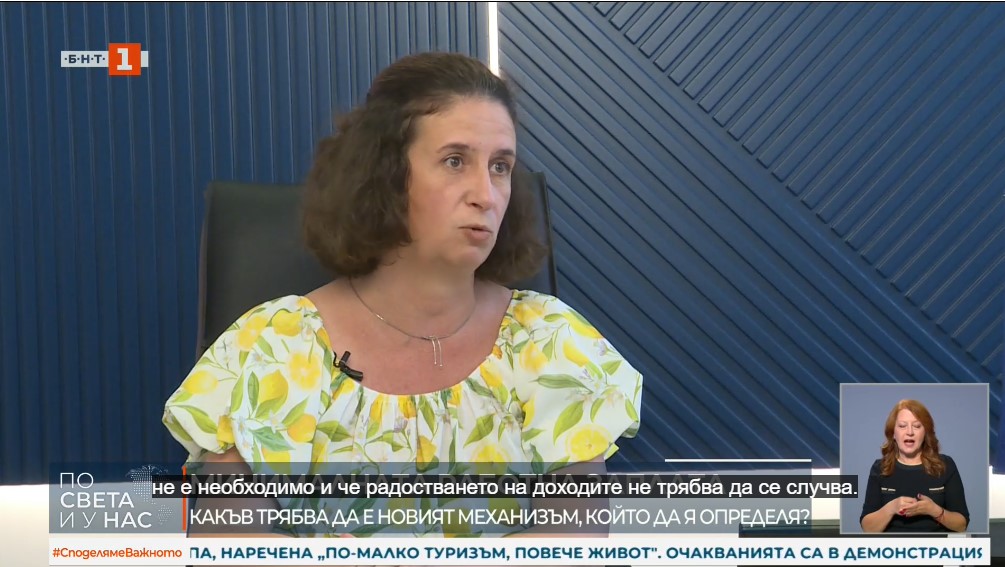
Hristina Hristova, former Minister of Labour and Social Policy: “This is a flawed transposition of European law into Bulgarian law because, in fact, there are no criteria. Suddenly, an automatic mechanism was introduced, which also rules out social dialogue and prevents discussion of very important criteria such as productivity, inflation and the overall level of income in the country.”
Under the European directive, an adequate minimum wage is indeed one that is at least 50% of the average wage or 60% of the median wage. However, this does not exhaust the mechanism for determining it. Trade unions opposed scrapping the automatic mechanism, although they agree that the methodology should be changed.
Lyuboslav Kostov, Chief Economist of CITUB: “At present, the existing mechanism would result in a minimum wage of €700 as of January 1, 2027. They are removing it for now, and nobody in the country knows what the minimum wage will be next year, because the law says that if there is no mechanism, the current minimum wage in euros will remain in effect. In my opinion, this was not the right thing to do.”
According to the economist, workers now have no bargaining leverage.
Lyuboslav Kostov, Chief Economist of CITUB: “Which business is going to sit down and negotiate with us when there is no longer anything to negotiate? Once there is no provision in the law, businesses can simply say from now on that they will not negotiate and that they are fine with the current minimum wage.”
Businesses, however, do not share this view.
Jasmina Sarаivanova, Director of Industrial Relations, BIA: “We absolutely do not believe that increasing the minimum wage is unnecessary or that incomes should not grow. What we want is for the mechanism by which this happens to be predictable.”
According to employers, the specifics of individual professions should also be taken into account, as well as the added value they generate and how effective the work is.
Jasmina Sarаivanova, Director of Industrial Relations, BIA: “The appropriate mechanism would be one that takes into account a range of economic indicators, including productivity, the growth of average and median wages, the labour market and economic realities.”
Lyuboslav Kostov, Chief Economist of CITUB: “For us, it is important that the minimum wage be adequate, and we maintain that the current level is not adequate. It needs to be higher. Otherwise, you work and you are poor.”
At the same time as developing the mechanism, Bulgaria must also transpose the European directive on adequate minimum wages into national legislation, as the deadline has expired and infringement proceedings could be initiated.
Hristina Hristova, former Minister of Labour and Social Policy: “When such infringement proceedings are launched, there is usually monitoring and recommendations, with criteria being set for what needs to be implemented. But the second stage always involves sanctions, and I would not want that to happen to us.”
If no mechanism is agreed, the government will have to determine the level of the minimum wage by a decision of the Council of Ministers.