Budget 2026 is not significantly different from those of 2024 and 2025. Our expectations are focused more on Budget 2027, where we hope to see bolder decisions regarding public-sector spending. We expect the tax and social security model to remain unchanged in the next budget and the maximum social security income threshold not to be raised again following its increase this August. All eyes now seem to be on a month or a month and a half from now, when the initial draft budget for next year is expected to be presented.
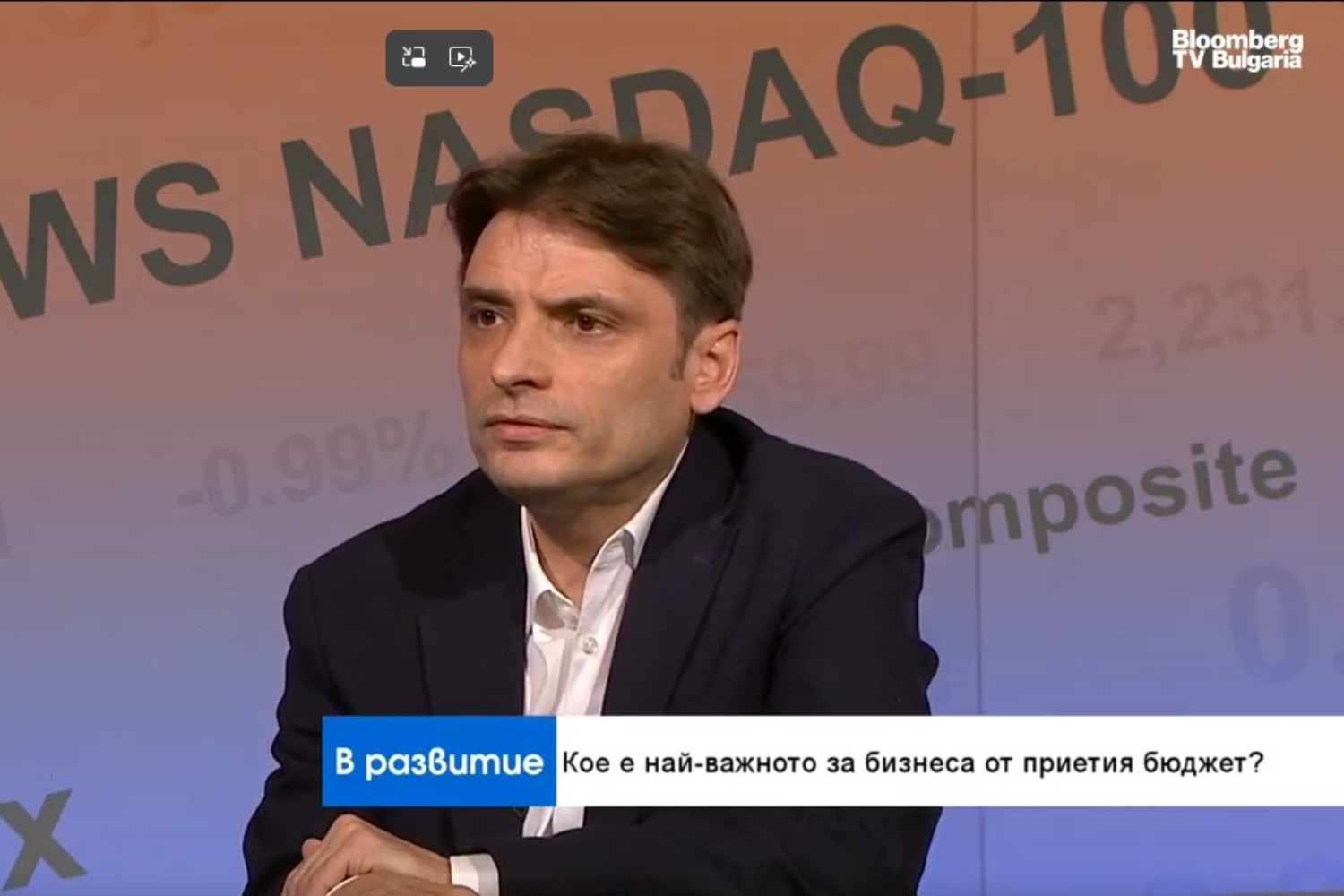
This was stated by Stanislav Popdonchev, Vice President and Chief Financial Officer of the Bulgarian Industrial Association (BIA), on Bloomberg TV Bulgaria’s “In Development,” hosted by Georgi Mesrobovich.
The 5.7% deficit envisaged in Budget 2026 is excessively high, which is why Bulgaria is subject to the EU’s excessive deficit procedure.
However, this year’s budget is being adopted at the end of July, meaning that it will be in effect for only five months. Therefore, everything we are seeing in terms of the deficit is the result of policies implemented in previous years.
“Budget 2026 is not significantly different from those of 2024 and 2025.”
Our expectations are focused more on Budget 2027, where we hope to see bolder decisions regarding public-sector spending, Popdonchev said.
Some mechanisms are currently being frozen, but not abolished. One of these is the mechanism for determining the minimum wage, which needs to be revised so that the minimum wage is determined not by an automatic formula but through dialogue between the social partners and the government, taking into account inflation, the average wage, labour productivity, and sectoral and regional specificities.
Businesses were unpleasantly surprised by the increase in the maximum social security income threshold and the minimum social security thresholds, he said.
“We expect the tax and social security model to remain unchanged in the next budget and the maximum social security income threshold not to be raised again following its increase this August.”
In many parts of the country, municipalities are major employers, with public-sector wages being roughly comparable to those in the private sector.
It is unfair for someone working half a working day to accrue the same length-of-service entitlements as someone working full-time.
“Foreign investors see the excessive deficit procedure, which is due to the deficit expected in 2026 rather than deficits from previous years.”
This is certainly a negative signal for credit rating agencies as well, particularly in view of how Bulgaria will finance its debt going forward, which has itself already become quite substantial.
“We hope the government will draw up measures to reduce this deficit more quickly than currently envisaged in the medium-term budget forecast.”
All eyes now seem to be on a month or a month and a half from now, when the initial draft budget for next year is expected to be presented, the BIA Vice President said.
Tax reform should not be undertaken without an in-depth debate because one of the few advantages businesses currently have when considering investment in Bulgaria is the country’s tax system, which is relatively simple and easy to understand.
“It is, in fact, proportional and the fairest of all the systems that exist.”
This does not mean that discussions and reforms should not take place, particularly in the area of social security and also in the healthcare system. Before changing the model, however, it is necessary to identify where the weaknesses are and where funds are being lost. Only then should there be a discussion about changing the models or increasing contributions for businesses and citizens.
In the context of the international situation, it can be said that any inflation helps the finance minister when it comes to meeting budget revenue targets, the economist noted.
“This is the environment we will have to get used to. It will be a difficult year, particularly if the conflicts continue. Although Bulgaria has no problems with fuel supplies, it is still affected by their price.”
Bulgarian businesses appear to have performed relatively well since the beginning of the year. However, there are signs of volatility. The negative three-year trend in industry had only just been reversed, and now we are once again seeing some slowdown.
Businesses will nevertheless manage, provided there are no major regional or global shocks or major surprises in the next budget, Stanislav Popdonchev said.