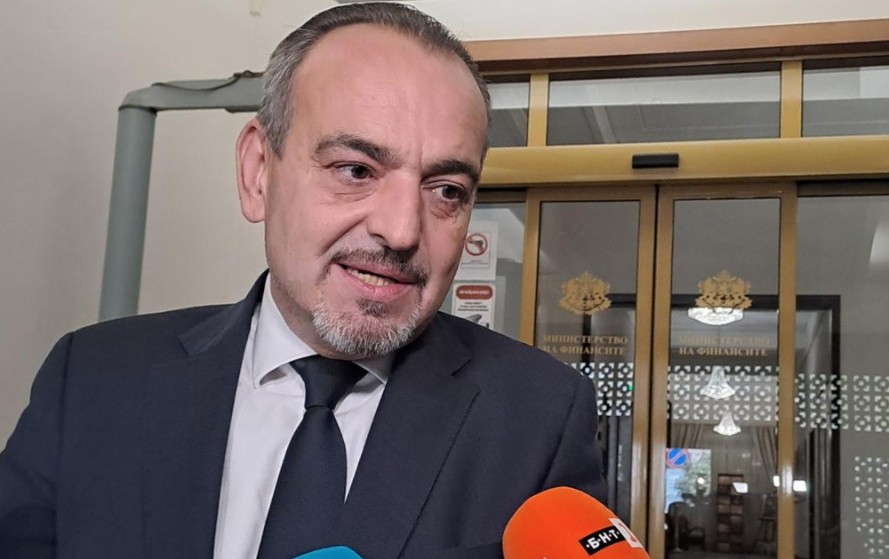
PRESIDENT OF BIA DOBRI MITREV CALLS FOR A BALANCED APPROACH TO SETTING THE MINIMUM WAGE
A balanced approach should be followed, seeking a middle ground for the minimum wage between the lowest and highest possible levels, as inflation affects not only employees but also businesses and their capacity to operate. This was stated by Dobri Mitrev, President of the Management Board of the Bulgarian Industrial Association (BIA) and rotating Chair of the Association of Bulgarian Employers' Organisations, following a meeting between representatives of employers' organisations and Finance Minister Galab Donev at the Ministry of Finance. The meeting focused on the 2027 budget procedure.
The government has proposed setting the minimum wage at €660 as of 1 January 2027. Mitrev noted that the proposed amount is close to what employers had anticipated, although their forecast had been for a slightly lower figure.
“Our forecast was for a slightly lower figure. Inflation is expected to slow significantly next year, so I believe the government should accept the proposed amount, disregarding the pressure that politicians and trade unions are trying to exert,” Mitrev said. “We need to be reasonable, because the economic and fiscal situation is far from favourable,” he added.
Mitrev pointed out that data from the National Statistical Institute and Eurostat indicate a significant slowdown in industry and exports, alongside ongoing geopolitical challenges. Higher electricity, petroleum product and natural gas prices are expected to result in increased costs for businesses.
“When these factors are combined with additional wage costs, which have increased by double-digit percentages over the past few years, they demonstrate a well-known economic principle: when incomes rise, prices also increase, but unfortunately, at a faster rate than incomes,” Mitrev noted.
“It is not so much the amounts that concern us as the unpredictability. No one can plan their budget for the coming year,” he stated.
At the meeting, the parameters of the 2027 budget plan were presented, along with explanations of the proposed measures. Mitrev welcomed the government's approach of consulting employers at an early stage and seeking their proposals and views on how to strike a balance between revenues and expenditure.
He clarified that what has been presented so far is a budget plan rather than a final budget, and that an expert assessment can only be provided after a detailed review of all the figures.
Asked which aspects of the budget plan were of concern to employers' organisations, Mitrev highlighted the proposal to increase the maximum social security income threshold by a further €100 as of 1 January 2027. He stressed that the concern was not so much about the amount itself, but rather the fact that the threshold had already been raised from €2,130 to €2,300 just two months ago.
According to him, this makes it difficult for businesses to plan ahead and maintain predictability. “This is concerning, although, on the other hand, the Finance Minister's efforts to secure additional revenues are understandable,” Mitrev commented.
Asked about the projected revenues in the draft budget, he said he was not convinced that they had been underestimated.
“You can see what is happening in the region and what is happening with prices. Unfortunately, all these developments could also affect the labour market and, consequently, consumption, which would be concerning and highly undesirable. Let us hope this does not happen, but it is better for the Finance Minister to take a more conservative approach when forecasting revenues than when forecasting expenditure,” Mitrev said.