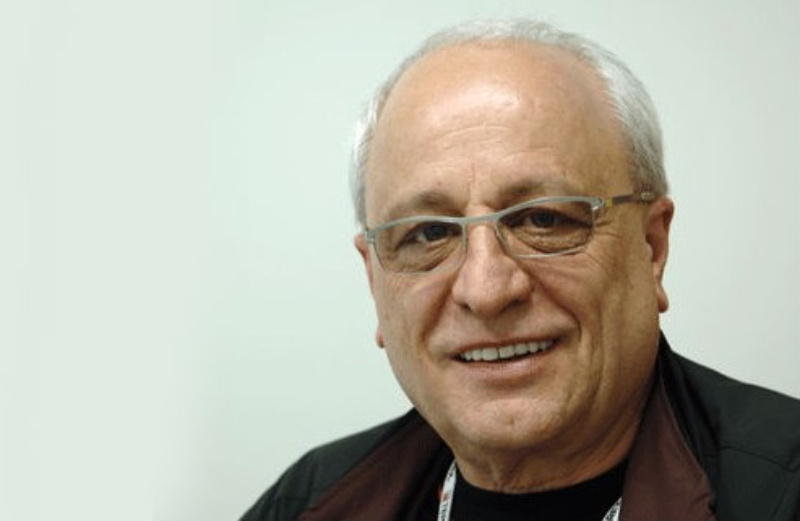
FIL FILIPOV: BULGARIANS MUST LEARN TWO THINGS: DISCIPLINE AND QUALITY
On April 16, 2019, one of the most successful managers worldwide – Fil Filipov – visited the Bulgarian Industrial Association, where he officially received a certificate confirming his status as an honorary member of the BIA.
Fil Filipov is President of Terex Lifting, a company that is part of the Terex Corporation, with capital amounting to USD 1 billion. Filipov owns factories in 15 countries, including Germany, China, Mexico, France, and Bulgaria. One of his most recent investments was the 2017 acquisition of the French metallurgical plant TIM, which had been declared insolvent. Filipov saved nearly 500 jobs, and today TIM’s main client is the American heavy construction equipment giant Caterpillar. Despite his success in the Western corporate world, Fil Filipov is not very well known in Bulgaria, yet he is among the few Bulgarians who have reached the top of the corporate hierarchy in the United States.
He was born in Strelcha. At the age of 17, he fled Bulgaria, passed through a refugee camp in Greece, and then emigrated to the United States. He built his career from the very bottom, starting as a worker and rising to the top of management, staying true to the belief: “Take control! Take risks! Achieve success.” In 1966, Fil Filipov began working as a sweeper at the lifting equipment company International Harvester. Gradually he advanced, and in 1979 he was sent to the company’s office in Paris. Ten years later, he left and started his own business: buying companies in severe distress and turning them around through brutal discipline. His specialty is the revival of loss-making enterprises. He has worked successfully in this field in France, the United Kingdom, Germany, Italy, and the United States, applying unconventional and original approaches. He has restored 49 enterprises, one of the latest being Atlas in Germany, which later became the owner of the Tatra automobile plant in the Czech Republic.
____________________
We present to you an improvised interview that Fil Filipov gave in response to questions by Radosvet Radev, Chairman of the BIA.
____________________
Tell me, in your opinion, is there something in the Bulgarian gene that makes Bulgarians good leaders, good managers?
Over the past 30 years, Bulgarians have been changing. Many Bulgarians are like sponges so they learn quickly. The encouraging thing about Bulgarian business is that here, in Eastern Europe, we are beginning to pay attention to what is being done in the West, and, just as the Japanese did in the postwar years, it is impressive that many of our companies and managers perform quite well in the West. But there are still people in Bulgaria who live in the past. We need to copy the Germans and the Japanese a bit more - we lack discipline and a sense for quality. We are not consistent either in discipline or in quality.
In your successful managerial career, you have always done things differently from what is generally accepted…
I am very good when the weather is bad. I have always said: “If you want to be loved, buy yourself a dog!” I don’t want to be loved; I go where there is something to be saved. But I also don’t think I am hated. I am respected. Someone who sees that I want what is best for the company cannot hate me. And salvation lies with the one who can cut deeply enough, if necessary, 15 times because it hurts. You must be able to cut deeply enough in order to save.
Tell the story of your battles with trade unions, it is very instructive.
Trade unions are the result of bad management. When there are bad managers, there are strong trade unions. When there are strong managers, there are no trade unions. I always tell unions: “I will work with you, but I will not work for you.” I have had strikes in 15 different countries. I have bought 49 companies in 15 countries. The company with the most employees was Tatra – 12,800 people. My most difficult relations with trade unions were in Germany, and the most undisciplined unions are in France, because there you never know when they will go on strike. My toughest strikes were in Germany. Three factories were blocked for six and a half weeks. I used a helicopter to enter and take parts for my customers. I have been taken to court in Germany 980 times, I am one of the most sued people in Germany. The national sport in Germany is the courtroom, because they have legal insurance. I have been sued for extremely ridiculous things. For example, I bought a house next to the plant, and because they hated me for wanting to make layoffs, they threw paint into my garden. I installed security cameras, but they sued me because I hadn’t asked their permission to install cameras. Another example: I buy a company that is losing €1.5 million per month. The unions come to me and ask for a three-year plan. I tell them there is no way I can know what will happen to the company over the next three years. They sued me for that.
Seven or eight years ago, I was the most hated manager in Germany after I carried out layoffs at Atlas. At that time, the newspapers exploded. Why don’t they write now, when the companies are doing perfectly and the workers earn more than at Mercedes?
Why do you call yourself a “doctor of sick companies”?
I call myself a “doctor of sick companies” because nobody wants them. I never look for companies and never compete to buy them – companies come to me to buy them. I am not even a human doctor; I am a veterinarian. When I take over a company, nobody tells me where it hurts, like a dog that can’t tell you where it hurts. I am a dog doctor: I come, I look, I read, and I know where the pain is.
How long does it take you to understand the defects in a sick company?
It depends. Two to three hours walking through the factory, looking at the financial statements from recent years, and I already know where the mistakes are.
Is there a recurring pattern of mistakes, some kind of typology?
Only one – bad management.
Where do you feel most comfortable doing business?
In Germany. I love France, since I have had business there for 40 years, my wife is French, I know the French, and life in France is very pleasant. Some time ago, the French finance minister called me in Chicago to ask me to turn around a company, 24 hours before it was to be declared bankrupt, with 440 employees. They were losing €1.5 million per month. A year and a half later, we are at break-even. For the first time, the trade unions did not strike for even a minute, because they themselves were part of bringing me in, since they knew I had successfully turned around other companies in France.
I love France and the French, but in Germany, business is business. No one interferes with me. The social security burden is only 24%. They are disciplined and hardworking. I recognize Japan and Germany as industrial nations that achieved economic growth after total wartime destruction solely thanks to two things – discipline and quality.
What is most important for good management?
Personal example. A manager must be the first at the factory if he wants discipline. I go to the factory at 5:30–6:00 a.m. Nobody has ever died from hard work. There is no other way. When you take over a company that is not performing, you can’t go to church to pray – you have to go on site and see what is happening. Another important thing: I have never brought in new people into a company I have acquired. I always find someone from within the company who rises up and takes responsibility. I don’t care who the person is, what ethnicity they are, how old they are, what education they have, etc. What matters to me is that they are responsible, motivated, and capable.