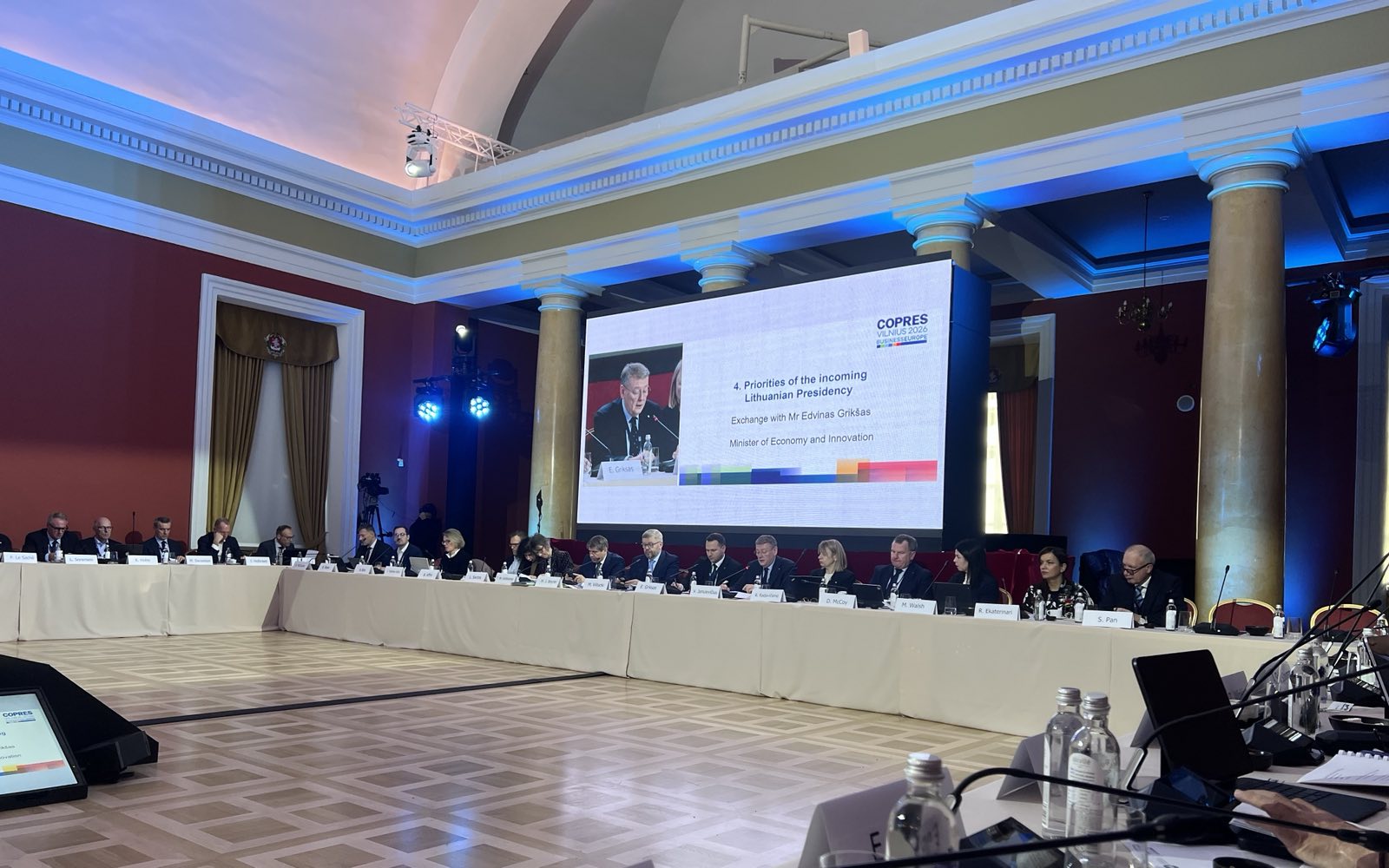
European industry is at risk, while the slow implementation of measures to strengthen the economy is exacerbating the challenges facing businesses. This is the warning issued by BusinessEurope in the Vilnius Declaration adopted on 27 November by the organisation’s Council of Presidents.
Entitled “Saving European Industry through Measures to Enhance Competitiveness”, the declaration sets out six key priorities on which European leaders must take concrete action during the first half of 2027.
According to BusinessEurope, growing geopolitical pressures, rising costs and accumulated regulatory burdens continue to undermine investment, economic growth and job creation across Europe. The organisation stresses that Europe's economic security and resilience depend on a competitive industrial base, reliable supply chains, secure critical infrastructure and businesses' ability to maintain operations in times of crisis.
SIX PRIORITIES TO RESTORE EUROPEAN COMPETITIVENESS
In its declaration, BusinessEurope calls on European leaders to focus their efforts on the following areas:
1. Reducing the regulatory burden and preventing overregulation.
The organisation calls for accelerated simplification of EU legislation, more efficient industrial permitting procedures and compliance with the commitment to reduce the regulatory burden by at least 25% for all businesses and 35% for SMEs. Proposals also include establishing a simple European company framework – EU Inc. – to facilitate business expansion across the Single Market.
2. Deepening the Single Market through a long-term vision.
BusinessEurope calls for the “One Europe, One Market” action plan to be complemented by a vision for the development of the Single Market towards 2035, supported by measurable targets for cross-border integration and the enforcement of Single Market rules. Priorities include removing existing barriers, facilitating labour mobility, improving the mutual recognition of qualifications and mobilising private investment.
3. Securing competitively priced energy and preventing carbon leakage.
Decarbonisation must enhance, rather than undermine, the competitiveness of European industry. BusinessEurope therefore calls for reductions in energy taxes, levies and network charges, the development of cross-border energy interconnections and storage facilities, and a technology-neutral energy framework for the period beyond 2030.
4. A Multiannual Financial Framework focused on competitiveness.
The next EU long-term budget must support private investment, industrial transformation and innovation. BusinessEurope insists that the proposed increases in funding for the European Competitiveness Fund, the Connecting Europe Facility, Global Europe and Horizon Europe should be maintained. The organisation also opposes introducing new business taxes to finance the EU budget, including the CORE levy and a digital services tax.
5. Trade diversification and a level playing field.
The declaration calls for an ambitious trade policy, expanded access to growing markets and diversified supply chains. Particular emphasis is placed on defending European economic interests against unfair trade practices, including state subsidies and industrial overcapacity, as well as stabilising trade relations with the United States and deepening cooperation with the United Kingdom.
6. Leveraging Europe's security and resilience strategy to strengthen industrial competitiveness.
BusinessEurope underlines that security and defence have become integral parts of Europe's competitiveness agenda. The organisation calls for defence investment to also strengthen Europe's industrial and technological base, stimulate innovation and create highly skilled jobs, with particular attention to the needs of SMEs and producers of dual-use technologies.
EUROPE CANNOT ACHIEVE PROSPERITY THROUGH REGULATION AND TAXATION ALONE
In conclusion, BusinessEurope warns that Europe has talented people, innovative companies and a valuable industrial base, yet it is losing ground to global competitors, while industrial jobs are declining.
To restore its attractiveness as a place to invest and manufacture, the EU must deepen the Single Market, reduce the regulatory burden, address high energy costs and establish an ambitious financial framework. At the same time, it must defend its economic interests and promote trade diversification.
“There is no time to lose” is the unequivocal message from BusinessEurope's Council of Presidents.
The full text of the Vilnius Declaration is available in the attached document.