A new EU regulation on packaging and packaging waste will enter into force on August 12. It will have direct effect, with no possibility for individual countries to interpret and implement European rules differently. The regulation will be applied in the same way across all EU member states, meaning that the industry will have to keep pace with EU markets. All packaging will be subject to the same requirements, rules and documentation, and companies in the sector will have to compete on an equal footing across different markets.
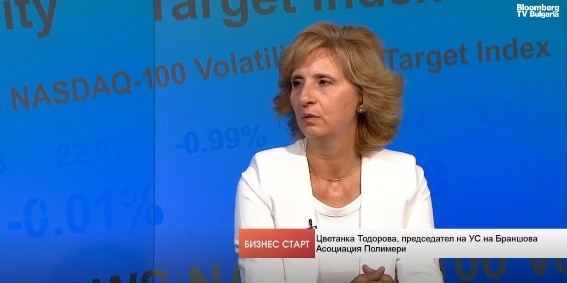
This was stated by Tsvetanka Todorova, Chair of the Board of the Polymer Industry Association, on “Business Start” on Bloomberg TV Bulgaria, hosted by Roselina Petkova.
According to her, this represents a major transformation for the entire sector, as a number of new requirements are being introduced that companies have no choice but to adapt to.
Significant costs for companies in the sector
The regulation requires many types of packaging to be completely redesigned to comply with the new rules. Companies in the sector will have to make significant compliance expenditures, while their documentation must meet all regulatory requirements, the guest noted.
She gave two examples of costs that companies in the sector will have to incur. A production line for some of the products that need to be adapted to the regulation's requirements costs between €3 million and €5 million.
“This is an investment that cannot be made all at once. Everything needs to be predictable and implemented gradually.”
As of August 12, packaging will also be prohibited from containing PFAS, substances that are hazardous to human health and do not break down naturally. Their absence or limited content must be demonstrated through appropriate analyses and certificates issued by certified laboratories, Todorova explained.
However, the necessary equipment is extremely expensive. There is currently no such laboratory in Bulgaria, meaning that the tests have to be carried out abroad, which places an excessive financial burden on businesses, she noted.
The end of multylayer packaging; monomaterials become the standart
The regulation also covers new products that will be classified as packaging, including coffee and tea capsules. If ordinary plastic coffee and tea capsules have been used until now, they will now have to be biodegradable. This will require changes to the production equipment used to manufacture such products, the guest explained.
“In a sense, we are seeing the end of multilayer packaging—not only because of the regulation, but also because, from a purely market perspective, such packaging will be phased out due to the introduction of environmental fees. The less recyclable a particular type of packaging is, the higher the fee imposed on it will be, and everyone will therefore seek to avoid using such packaging.”
Work is already underway to transition to packaging that is easier to recycle and complies with the regulation's requirements, Todorova said.
Packaging is easier to recycle when it is made from a single material, which is why the regulation encourages the use of monomaterials in packaging. Under the regulation, there are three different recyclability classes—A, B and C—and packaging must meet the requirements of these classes in order to remain on the market. Packaging with a recyclability rate below 70%, known as composite packaging, will be phased out.
The purpose of multilayer packaging is to protect food products from oxygen, heat and moisture, thereby preserving their quality. These barrier properties must now be replicated using a monomaterial.
“If, until now, the film used to package food was made up of five to seven different components, it must now consist of a single material that nevertheless provides all the functions of the previous packaging.”
In summary, the packaging of the future that complies with European requirements will be as lightweight as possible, made from a monomaterial, and feature a QR code and pictograms standardised across the EU, allowing all European citizens to easily check what material the packaging is made from and where it should be disposed of.
The packaging will have a very high level of recyclability and will meet circularity requirements, meaning that it should circulate repeatedly throughout its life cycle, the guest explained.
Packaging prices expected to rise
Higher packaging prices are inevitable due to the regulation's requirements and the significant amount of documentation involved, but this will happen gradually over time, Todorova said.
According to her, a bigger factor behind rising packaging prices is the tensions in the Middle East, higher raw-material prices and concerns about material shortages.
She said that following the outbreak of the conflict, raw-material prices had nearly doubled, while supply uncertainty had also increased. These factors have subsequently affected manufacturing.
“Manufacturers were forced to terminate contracts with counterparties because they could not maintain the prices agreed under long-term contracts.”
Todorova expressed hope that the conflict would end as soon as possible so that companies in the sector could operate in a more predictable environment.