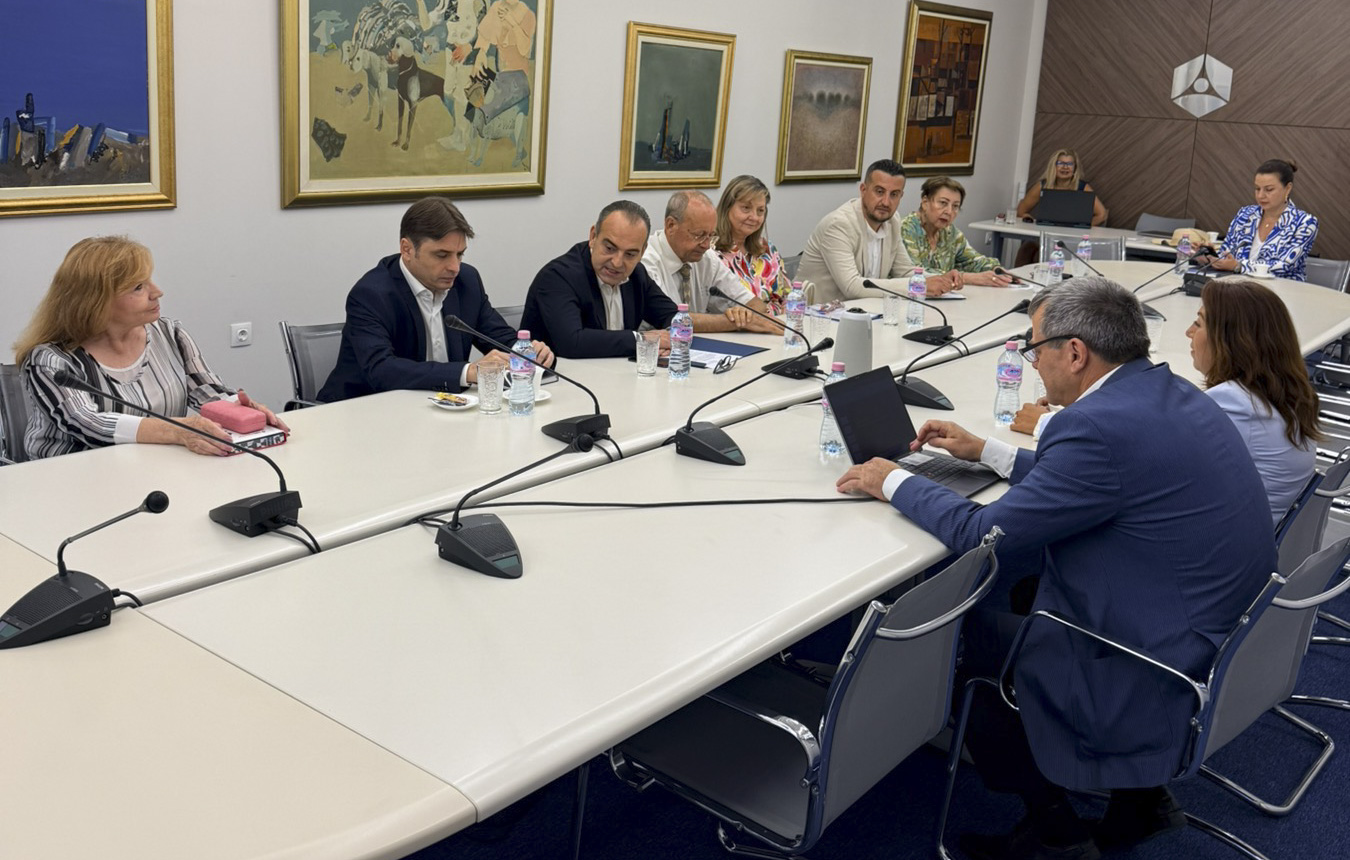
The processing times for applications submitted to the Commercial Register and the Register of Non-Profit Legal Entities were the subject of a working meeting between the new management of the Registry Agency (RA), represented by Executive Director Eliana Ilieva and her deputy Nikolay Minev, and the nationally representative employers’ organisations united in the Association of Bulgarian Employers (AOBE): the Bulgarian Industrial Capital Association (BICA), the Bulgarian Industrial Association (BIA), the Bulgarian Chamber of Commerce and Industry (BCCI), and the Confederation of Employers and Industrialists in Bulgaria (CEIBG).
The meeting was held on July 29, 2026, at the BIA headquarters, at the initiative of the Registry Agency.
Opening the meeting, AOBE rotating Chair and BIA Chairman Dobri Mitrev said:
“For businesses, fast and predictable administrative services are not a convenience but a fundamental prerequisite for normal economic activity. Delays in registrations with the Commercial Register create real difficulties for companies and affect the investment environment. We appreciate the readiness of the new management of the Registry Agency to seek solutions through dialogue with employers’ organisations, and we expect concrete measures to restore the normal pace of operations to be taken within a short period of time.”
RA Executive Director Eliana Ilieva said:
“We are taking over the management of the Registry Agency after a prolonged period of unresolved problems and accumulated backlogs affecting businesses and citizens. Of approximately 900,000 registered companies in Bulgaria, only around 10% have so far submitted applications for the conversion of their capital into euros under the Law on the Introduction of the Euro in the Republic of Bulgaria. We expect a peak period in September, because many companies believe that they need to submit the application together with their annual financial statements (AFS). This means that in September we expect more than 300,000 applications for capital conversion, which cannot possibly be processed within the statutory deadlines. In addition, the number of unprocessed AFS is expected to exceed one million, around 600,000 of which are already overdue from previous years. This means that by the end of the year, more than two million applications will have to be processed, while the current processing capacity is 2,000 applications per day. This would paralyse the system.”
RA Deputy Executive Director Nikolay Minev presented statistics on the most problematic aspects of the Agency’s operations and its key registers, calling for the full digitalisation of interactions between businesses and the Registry Agency, as well as between the Registry Agency and the administration.
This would significantly streamline the process of validating the information contained in submitted applications, which is currently largely manual and based on scanned documents.
“Even now, between 20% and 30% of applications are still submitted at service counters. A whole hall of employees is maintained to handle these applications, although these employees could instead serve as registration officials,” Mr Minev added.
The employers’ organisations identified the need for regulatory and organisational measures to accelerate the processing of applications as an extremely urgent priority, including by separating the three application streams: annual financial statements, applications for changes to registered circumstances, and applications for capital conversion.
They expressed their readiness to support the management of the Registry Agency in preparing the necessary legislative amendments within the shortest possible timeframe.
The meeting also discussed potential funding opportunities for the full digitalisation of the Registry Agency’s processes. Employers were informed that the project originally planned for this purpose had been removed from Bulgaria’s National Recovery and Resilience Plan. In this regard, the employers’ organisations proposed that the digitalisation be financed from the Agency’s own revenues.
Representatives of both sides agreed that it is high time for the Registry Agency to start using the latest technological solutions, including artificial intelligence, in order to optimise services for businesses and citizens and ensure that applications are processed within the statutory deadlines.