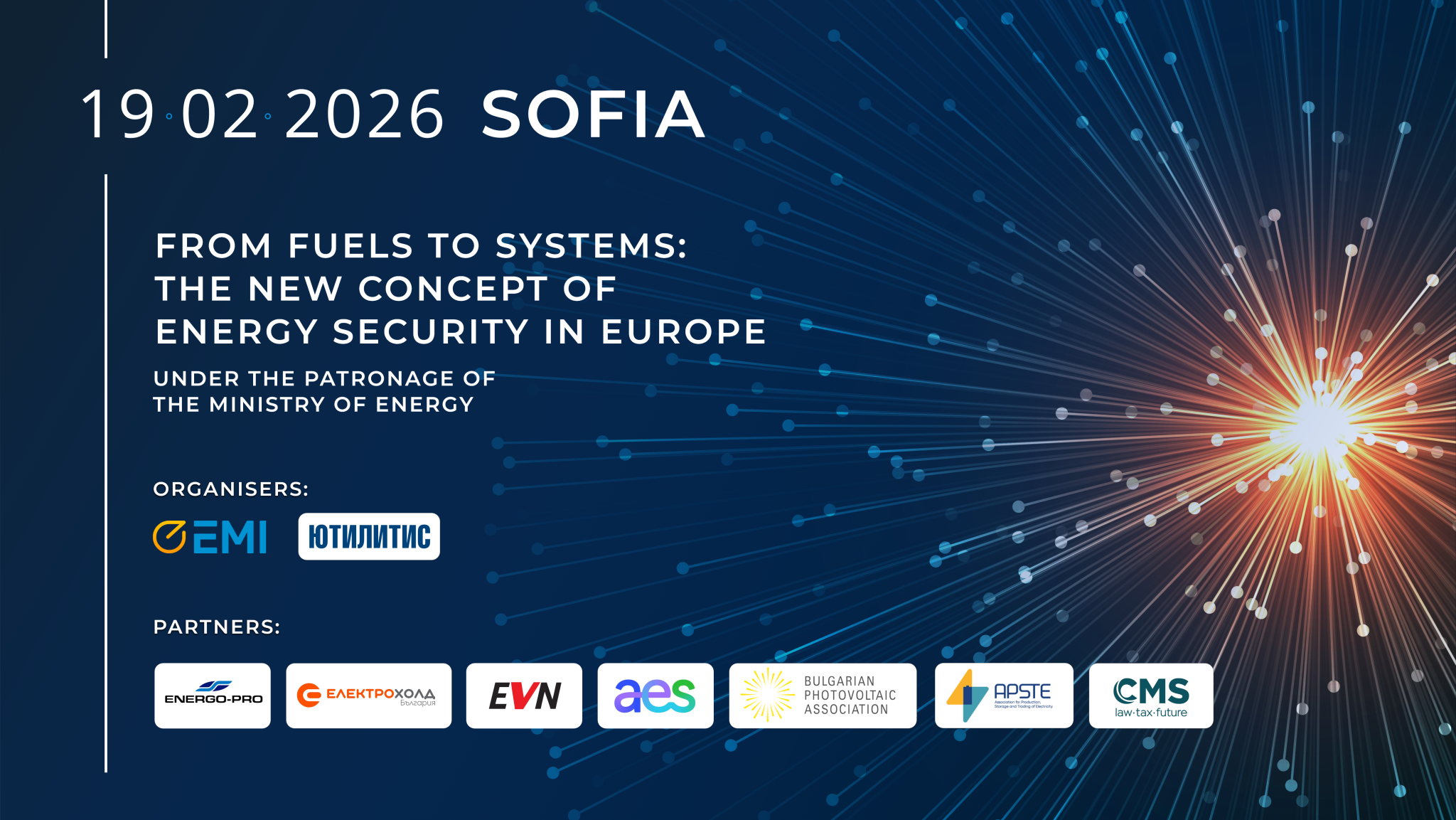
On February 19, 2026, the Energy Management Institute and Utilities magazine brought together key representatives of national and European institutions, energy companies, industry associations, and diplomats to discuss the various components of energy security—geopolitical, technological, financial-economic, climatic, and others—in the context of an increasingly electrified and RES-dominated energy system. The key speakers were:
- Tsvetelina Penkova, MP, Vice-Chair of the Committee on Industry, Research and Energy, European Parliament and a lead negotiator for the European Parliament on the Trans-European Energy Infrastructure Regulation (TEN-E);
- Mónika Zsigri, Head of Unit, DG ENER Energy Security and Safety, European Commission;
- Nic Steinwand, Policy Advisor – Energy Policy, Climate & Sustainability, EURELECTRIC;
- Fabien Roques, Executive Vice President & Head of Energy Practice, Compass Lexecon;
- Eng. Dimitar Zarchev, Director National Dispatching Center, Electricity System Operator
- Plamen Mladenovski, Chairman of Energy and Water Regulatory Commission.
The event was moderated by Kaloyan Staykov, Chairman of the Board of EMI, and Assoc. Prof. Atanas Georgiev, Dean of the Faculty of Economics and Business Administration at Sofia University and Editor-in-Chief of Utilities magazine.
Energy security has established itself as a critical pillar of European policy, alongside climate goals and the pursuit of affordable energy. Ensuring reliable supplies requires a system capable of absorbing shocks of various kinds, adapting to dynamic conditions, and guaranteeing continuity without compromising long-term sustainability and economic stability.
Geopolitical tensions around the world add new dimensions to energy security. It is impossible to predict what further difficulties may arise in the supply of energy, zero-emission energy production technologies, rare raw materials, and critical materials needed for the transition to a carbon-neutral economy. The predictability of Europe’s international partners has been lost, and the war in Ukraine also poses risks to the physical security of energy assets. Even outside of a war scenario, European power grids are already being tested by hybrid and cyber attacks.
On the other hand, the process of decarbonisation by 2050 implies a profound transformation of the energy system, in which security requirements must be uncompromisingly observed at every stage, and the new challenges facing energy system management require the use of complex solutions in both the short and long term.
Electricity is undoubtedly establishing itself as the dominant energy carrier, including for achieving strategic energy autonomy. Over the next 30 years, electricity consumption in Europe is expected to grow by more than 2,000 TWh – four times more than the increase over the past three decades.
Already, nearly half of Europe’s electricity mix comes from renewable energy sources (RES), and their share will continue to grow. Although they are key to decarbonization, their variable nature poses new challenges to maintaining secure and consistent supplies.
While RES capacities with variable production are growing exponentially, the maneuverable capacities that provide the necessary flexibility and system services are not only failing to keep pace, but are actually decreasing. Part of the dispatchable conventional capacity, which until recently was the foundation of energy systems, is gradually exiting the market. Between 2018 and 2024, dispatchable capacity in Europe decreased by about 10%. The dramatic 45% reduction in fossil fuel-based electricity generation capacity in Bulgaria and 38% in Romania has led to a deterioration in the stability of the electricity transmission network and high market prices in the region during the same period.
The extremely high energy prices in the region of Southeast Europe in recent years have become a serious problem for the competitiveness of the economies. The price differences with Central and Western Europe are largely reflected and create uncertainty in the way the EU energy system is set up and undermine confidence in both the internal European energy market and the adequacy of European energy and climate policies.
The two problems can be summarized as follows: how much does a unit of necessary but undelivered electricity cost, whether due to supply interruptions or prohibitively high prices? Spain is currently facing an avalanche of lawsuits seeking compensation for power outages last spring. This incident, as well as a number of similar ones last year, suggests the need for “insurance” — a necessary surplus (reserve) of capacity in the system that can provide both system services and have the maneuverability to complement the variable generation of RES, as well as replace that generation when sunshine, wind power, or water resources are below forecast. The increasing electrification of economic and social processes is transforming the sector, and a unit of undelivered electricity can end up being many times more expensive than the cost of “insurance”, which reduces the risk of power outages.
In a recently published study by Compass Lexecon, assessments of the adequacy of the Bulgarian electricity system indicate limited risk in the short term but highlight the existence of significant uncertainty. Similar conclusions are drawn in the latest 10-year plan of the Electricity System Operator for network development (2025–2035), which emphasizes the role of conventional thermal power in maintaining system stability and adequacy. An increasing share of domestic consumption is expected to be covered by imports due to the declining competitiveness of coal-fired power plants (their output is expected to amount to around 3 TWh in 2026 and fall to 0 TWh by 2030). This creates potential risks to system stability, as well as the risk of increasing costs for businesses and households.
With the increase in the share of RES and the decommissioning of existing lignite-fired power plants, the volume of balancing services required will also increase. Challenges related to frequency, voltage, and inertia in the system are possible. The necessary operating parameters must be maintained within working limits to avoid system crashes and cascading failures – processes similar to those observed in Albania, Bosnia and Herzegovina, Spain and Portugal, North Macedonia, Serbia, France, and the Czech Republic over the past year.
It should also be noted that coal-fired power plants continue to be considered key to the restoration (restart) of the electricity system in crises, given the still limited energy storage capacity.
Possible solutions that keep the operating parameters within the required limits include the commissioning of various technological assets (CCGT, hydropower, nuclear energy, batteries, H2), the participation of DSR in balancing, new market mechanisms to ensure minimum synchronous production in the system, etc.
During the discussion, participants clearly identified the management of the impact of negative prices as a serious challenge. This affects all market participants. To reduce the number of time intervals with negative prices, a higher share of maneuverable capacity, a better integration of the regional market into the pan-European market, but also proper management, mainly of photovoltaic energy at the regional level, are needed. This is particularly true with regard to the review of renewable energy subsidy mechanisms in Central and Western Europe, which currently do not encourage their restriction during hours with negative prices.
Batteries are part of the solution to high price volatility, but not entirely. The introduction of batteries in Bulgaria was expected to reduce price fluctuations by activating storage during hours of intense sunshine (when prices are lower) and releasing this energy at night. The reality in Bulgaria at the moment shows that they tend to act in a purely business-oriented manner, generating income from profitable price arbitrage at 15-minute intervals, without necessarily behaving in a way that serves to balance the system or reduce average exchange prices.
Incentives are needed to change the behavior of battery operators so that they do not create additional problems in balancing the voltage – a conclusion that the regulator has already made and will soon propose appropriate changes to the subordinate legislation.
Over the past year and a half, short-term energy storage capacities in the country (batteries) have increased significantly and will continue to grow as a result of the financial support provided under the RESTORE program, part of the PUV. At the same time, national projects for long-term energy storage, both traditional ones, such as pumped storage hydroelectric power plants, and innovative ones, such as molten salt thermal energy storage technology, still rely on pure market premiums. The so-called missing money problem , with various types of capacity mechanisms and flexibility contracts being part of the solution, which, in compliance with the rule of technological neutrality, can be decisive for investors to take the risk of implementing larger-scale projects.
Many EU countries have already implemented or reformed existing mechanisms for concluding adequacy and flexibility contracts. The latest legislative reform of the European Market Design (EMD) and CISAF accelerate the approval of market capacity mechanisms. They also encourage flexible capacity contracting (as a separate scheme or accompanying capacity mechanism).
Adequate, reliable, and well-interconnected energy networks are a prerequisite for a well-functioning internal energy market and security of supply. Since 2013, the EU has taken an important step towards identifying and facilitating the implementation of key cross-border investments by adopting the Regulation on Trans-European Energy Networks (TEN-E). The European Energy Grids Package announced in December 2025 includes a review and simplification of the Regulation.
With regard to TEN-E, the proposal introduces new funding categories for sustainability and digitalization. It introduces a scenario for centralized planning across the EU and stricter rules for cross-border allocation of benefits and costs. These two elements are currently the main topic of debate in the Council of the European Union. A change in the criteria for project approval is expected. It is extremely important that projects be selected not only according to a set of criteria, as has been the case so far, but also on the basis of the extent to which they facilitate the integration of markets in the EU.
Distributed renewable energy production and active consumption management are an important part of the solution to fossil fuel dependency, more affordable prices, and better protection against the consequences of a potential physical attack on energy assets. At the same time, the “smartening” of transmission and distribution networks, and with them buildings and businesses, is key to the effective management of energy flows from decentralized production. However, digitalisation brings with it increased vulnerability to cyber attacks, and investments in security must be part of business planning.
The investment framework in the country should be designed in a way that takes into account the changing needs of the system. In the context of the formation of market zones within the EU’s single electricity market, government policies should be more conservative and return to basic principles, first ensuring security of supply at the local level, then at the regional and European levels.
For more information about the program and participants in the event, please visit the link. Presentations by the key introductory speakers as well as pictures can be downloaded from the links below:
- Nic Steinwand, Eurelectric, Redefining energy security
- Fabien Roques, Compass Lexecon, The need for investment in stable and flexible capacity and the “missing money” problem