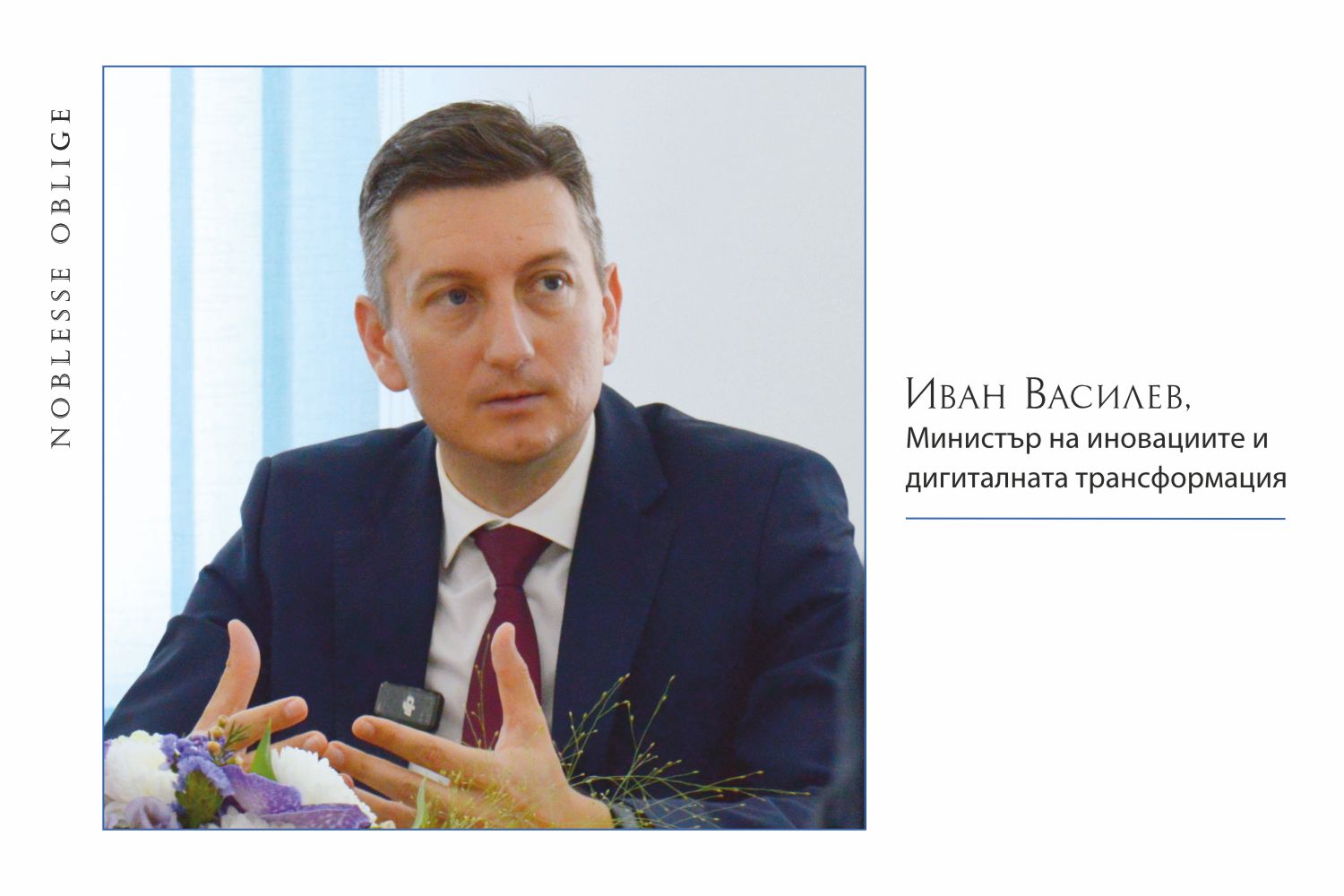
Ivan Vassilev, Minister of Innovation and Digital Transformation
Ivan Vassilev has many years of expertise in the field of economics and finance, as well as in the creation and management of economic policies and technological projects. Since May 8, 2026, he has been the Minister of Innovation and Digital Transformation (MIDT). The new ministry unites the Ministry of e-Government and the Ministry of Innovation and Growth.
Mr. Minister, Bulgaria has a strong ICT sector, talented specialists and successful technology companies. What should we do to turn this advantage into a sustainable competitive advantage for the entire Bulgarian economy?
We have set an ambitious goal - for Bulgaria to become the best place by 2030 to start and develop a business with high added value, based on innovation. The country to establish itself as a European leader in the digitalization of the public sector and an innovation hub, where the administration works for citizens and businesses, and where new technologies create highly qualified jobs and sustainable economic growth.
Let's keep our talents here, and in parallel, work for easier access to financial instruments and more incentives for research and development. I deeply believe that innovative companies are the engine of economic transformation. We have the political will and the ambition for the state to stimulate the development of high-value-added businesses in order to open high-paying jobs. The state must now be an accelerator of innovation and technological development, not a passive observer.
There is no doubt that we have extremely successful companies in Bulgaria. A few weeks ago, in early September, the Bulgarian company EnduroSat signed a key space memorandum with Arianespace at the Elysee Palace. This happened in the presence of Prime Minister Radev and President Macron during the International Space Summit in Paris, in which I participated. Bulgaria has more than 50 years of history in space research and technology, and this history continues with Bulgarian companies that today are building technologies, attracting investments and working with some of the largest companies in the European space industry.
What does the Bulgaria you would like to see in 2030 look like?
I want to see Bulgaria with a transformed economy based on knowledge, technology and productivity. As an established European leader in the digitalization of the public sector and an innovation hub, where the administration works for citizens and businesses and where high technologies create sustainable economic growth. To this end, we need to emphasize capacity building in strategic and critically important technologies such as artificial intelligence ( AI ), robotics, drones, microelectronics and anything else that will contribute to high-tech production and services. Our Management Program clearly and with specific deadlines sets out the steps to achieve this. The goals set for the Ministry of Innovation and Digital Transformation are bold and ambitious. I believe that we will be able to implement them within the mandate.
How can the state help small and medium-sized enterprises digitize their businesses without digital transformation becoming just another program for purchasing equipment and software?
The digitalization of Bulgarian enterprises has always been the focus of the Ministry's support. Digitalization is a key prerequisite for advancing the business models of companies , achieving greater efficiency and promoting their sustainability, as well as creating new opportunities for higher profitability, especially for small and medium-sized enterprises. Support for this is provided through the two European programs - "Competitiveness and Innovation in Enterprises" and "Research, Innovation and Digitalization for Smart Transformation". In order to achieve digitalization of the business, the processes are inevitably related to the acquisition of the relevant assets, software and technologies, but the support is aimed not only at the investment, but at achieving a measurable result - a real increase in the level of digitalization. Training is planned for working with the implemented solutions, integrating and managing the systems and monitoring their effective use, taking into account the digital maturity of the enterprise. Digital solutions are also included in the measures for entrepreneurship, energy efficiency and innovation. The European Digital Innovation Hubs play a significant role in the digitalization process, supporting businesses and public organizations through expert services, technological knowledge, and access to equipment and software, including for the implementation of artificial intelligence.
AI is already changing entire industries. Does Bulgaria have a chance to not just be a user of AI technologies, but to create products and companies that are competitive on the global market?
Yes, Bulgaria has this potential, and we are already seeing concrete results. INSAIT has developed and is further developing BgGPT – models adapted and further trained for the Bulgarian language on leading international developments. This is an example of how a scientific team in Bulgaria can create technologies with practical value for citizens, institutions and businesses. Google has already invested over 6 million dollars in the institute in the form of funding, computing resources and support for talent development, and in 2026 provided additional funding in the amount of 500 thousand euros for research in the field of artificial intelligence and robotics.
We are also developing the conditions for the next similar successes. The BRAIN++ project envisages an artificial intelligence factory with the Discoverer ++ supercomputer and services for the development and implementation of AI solutions. The GATE Institute at Sofia University also plays an important role with its work in the field of big data, artificial intelligence and the training of specialists.
Another opportunity is opening up for technologies with civil and defense applications. MADARA – the new center in Sofia Tech Park, which will be part of NATO's DIANA accelerator program from 2027. This will give selected innovators access to expertise, testing, and international partnerships.
Our task is to connect scientific results with funding and real market demand. The National Innovation Fund at the Ministry of Science, Technology and Innovation is one of the instruments for supporting the research and development activities of enterprises. Our goal is for more Bulgarian teams to successfully transition from development and prototype to their own product and international clients.
What should be the role of the state in the implementation of AI - regulator, investor, client, or "first adopter" of new technologies?
The state must fulfill all four roles simultaneously, but without replacing entrepreneurial initiative and market dynamics. Its task is to create the environment, tools, and conditions for development, not to displace business.
As an investor – through existing innovation support instruments, the state takes on risk in the earliest stages that private capital typically avoids. Our strategic goal is to sustainably expand access to financing for innovative enterprises, rather than relying on one-off interventions.
As a regulator, this role is not limited to building a technical infrastructure for testing. It means, above all, ensuring a stable, predictable and European-standard regulatory environment in which businesses can plan with confidence and without unnecessary administrative burden.
As a customer and "first user" - in this aspect there is still untapped potential. The public sector can become the first real customer for Bulgarian AI solutions before they enter international markets.
To ensure that these roles work together rather than fragmentedly, the creation of a new Council for Innovation and Technological Development was recently approved, which is a consultative mechanism connecting the executive branch with businesses, startups , investors and scientific organizations to improve the conditions for the development of technology companies. Its activities will be aimed at better coordination of innovation policies and developing recommendations for legislative and administrative changes.
At the Ministry, you already use AI in your daily work, and you have also created an informal “Robot Council.” What have you learned from this experiment, and are there areas where you would entrust AI with a real analytical or advisory role in decision-making?
The experiment started with one question: if MIDT doesn't test new technologies on its own work, who should we expect it from?! We started with Robert, but the idea is to expand this advice to other intelligent systems.
I believe AI is most useful where information is abundant and time is limited: summarizing voluminous documents and analyses, comparing options, checking the logic in an argument, preparing questions before a meeting. And the quality of the result depends entirely on the quality of the data and how precisely the task is set. And, perhaps most importantly, the technology asks uncomfortable questions without political constraints and without self-interest. In government, this is a rare and valuable perspective.
There are areas where I already see a real analytical and advisory role. The analysis of large data sets, the identification of overlapping procedures and processes between institutions, the assessment of the impact of a given measure, the preparation of scenarios for long-term solutions. We are also working in this direction in preparing realistic processes for automation. Here, AI can save teams months of work.
However, there is a limit, and it is that robots can have an advisory role, but not a decisive one. AI will not completely replace the administration, because it cannot be responsible for decisions. The signature will remain human, the direction is set by people, and citizens' personal data does not enter such systems without anonymization and protection.
AI is about to enter business more and more seriously. Is there a risk that Bulgaria will be unprepared in terms of personnel, infrastructure, and regulatory environment? What is the state doing right now so that we don't fall behind?
Bulgaria has a strong foundation: optical coverage is above the EU average, and overall 5G coverage is approaching it. We also have the Discoverer supercomputer , on whose experience the development of new capacity through BRAIN++ is based. However, the presence of technology does not automatically mean that every enterprise can use it. People are needed who understand the specific production or management problem, have appropriate data and can evaluate the result. Therefore, closer work between universities, scientific organizations and business is a priority, as well as access of enterprises to training, expertise and testing opportunities. Support must also reach companies outside Sofia. In terms of innovation policy, we are updating the Innovation Strategy for Smart Specialization. It must direct support to the changed technological and regional needs. Regulatory readiness requires separate work: a clear allocation of responsibilities, practical guidance to enterprises and conditions for testing AI solutions under competent supervision. For us, success should be measured by more prepared professionals and more businesses that use technology safely and productively.
One of your stated goals is for citizens and businesses to not provide the administration with documents that the state itself already has. When can we realistically expect this to become the standard, rather than the exception?
This should become a principle of the administration's work, not a separate service or good practice of any institution. The citizen should not be an intermediary between two administrations that already have the necessary information.
Our realistic approach is for this to happen in stages – first with the most frequently used administrative services and with data that is already available in key registers, and then to expand to all processes for which there is a legal and technical basis.
However, it is important to make it clear that digitalization does not simply mean replacing the paper document with a PDF. The real change is for the administration to extract the necessary data from government systems itself, instead of requesting it again from the citizen or business.
Our goal is the “once only” principle – that data is provided by the citizen once, and then the state can reuse it when the law allows. This is one of the clearest measures of whether e-government is actually working for people.
What is the place of data in this transformation? Can we talk about a truly digital state if the various state registries and systems still do not communicate effectively with each other?
Data is the foundation of the digital state. If systems cannot securely and efficiently exchange information, we are essentially just digitizing individual departments, not creating a unified digital state.
Therefore, the next step is not for each institution to create yet another system of its own, but for existing systems to start working as part of a common ecosystem. This means interoperability, clear data standards, reliable identification, and traceable information exchange.
At the same time, there must be a very clear line between sharing data between institutions, when necessary and legally permissible, and their uncontrolled use. The digital state must be not only faster, but also more secure and more transparent.
Ultimately, success will not be measured by the number of new information systems or electronic records. It will be measured by whether a person can receive a service without carrying a folder of documents from one institution to another. When the state starts to “connect the dots” itself, then we can already talk about a true digital state.
NIS2 places new requirements on business and administration. Where do you see the most serious risks in their implementation and how will the state help companies adapt?
NIS2 should not become another administrative burden for businesses. The goal of MIDT is to help increase the real cyber resilience of Bulgarian companies and institutions.
The most serious risks in implementing the directive are three. First – the shortage of qualified cybersecurity specialists. Second – the financial burden, which for small and medium-sized enterprises can be significant. And third – the risk of the focus being on the formal implementation of the requirements instead of on the real protection of systems and data.
Therefore, the state must be a partner, not just a control body. MIDT works for clear rules and practical guidelines, training and increasing expertise, as well as for the use of European and national instruments to support business.
The ministry pays particular attention to small and medium-sized companies, because for them investments in cybersecurity are often much more difficult to undertake. Through the project "National Coordination Center - Bulgaria" in 2025-2026, the Ministry of Information and Communications Technology provided grants of 2 million euros to 60 SMEs. The procedure allowed these enterprises to introduce modern cybersecurity solutions.
But the state must also set an example. If we want business to be cyber-resilient, public administration must be equally well protected and prepared. The project "Enhancing National Capabilities for Coordination and Response to Cybersecurity Incidents", implemented by the Ministry of Defense, aims to increase the national capacity for coordination and response to cyber incidents by building and modernizing the infrastructure and information systems for cybersecurity, as well as integrating public organizations into a single national cybersecurity system. The project involves 50 state administrations, for which hardware equipment has been purchased and software solutions are being installed to improve their level of cybersecurity and protection. The project represents a comprehensive strategic vision for building a centralized National Cybersecurity System, based on a common architecture, shared visibility, coordinated monitoring, analysis and response to cyber incidents.
Our approach is less bureaucracy, more real security, more support for business, and clear responsibility for non-compliance with the rules.
Where do you think Bulgaria's great untapped potential lies – AI, fintech , cybersecurity, robotics, deep tech , space technology or another sector?
Bulgaria's advantage lies in the combination of several areas in which we already have scientific, technological and institutional capacity, and our strategic goal is for this combination to position Bulgaria as a regional center for innovation, high-tech investments and the development of strategic technologies.
In the field of AI and high-performance computing, as I have already mentioned, we are building national capacity through the AI Factory BRAIN++ at the Technical University of Sofia, including second and third generation computing resources connected in a single national AI network. This goes hand in hand with long-term institutional support for the development of INSAIT as a leading European research center in the field of AI and informatics, and of the Technical University of Sofia as a European center for innovation, scientific research and high-performance computing. The development of this capacity will not only stimulate the local technological and scientific environment. We expect it to also support the attraction of investments, the development of high-tech enterprises, the implementation of AI-based solutions in the industry, as well as increasing the efficiency of public services. In the field of space technologies and secure satellite communications, we are developing capacity through the performance of the functions of a competent authority under the EU GOVSATCOM initiative and our participation in related European initiatives.
You say that “scientific discoveries should not remain in drawers, but should be transformed into market value.” How will this change be achieved in practice?
In practice, this means that even during the development of the technology, the question of who needs it and under what conditions would they use it should be answered. The scientific result becomes market value when it is tested in a real environment and finds a customer.
This is one of our major tasks and the main thing is to build a working relationship between science and business. Successful transfer of knowledge and technology requires an entire ecosystem. The Science and Business Program (PNIIDITT) is working in this direction. Its role, on the one hand, is to invest in the development and sustainability of the research infrastructure and the capacity of scientific organizations. On the other hand, it creates mechanisms through which enterprises can actually use the knowledge, expertise and equipment accumulated in universities and scientific institutes. The next step is to move from individual interactions between an enterprise and a scientific organization to larger-scale partnerships that can change the economic profile of entire regions.
If you had to choose just one digital change to be implemented by the end of your term and that people and businesses would feel immediately, what would it be?
I would not point out just one change by the end of the mandate. But I would point out the one that we are currently working on at an accelerated pace and will make every effort to launch by the end of this year. It is about the European Digital Identity Wallet. When I joined the Ministry, work on it had been stalled for the past two and a half years. Currently, active work is being done on the project. Through the digital wallet, citizens will be able to electronically verify their identity and gradually gain access to administrative services - from submitting tax returns and inquiries to the National Social Security Institute to healthcare services, personal documents and traffic police services. It is high time that citizens and businesses receive services from the state quickly, easily and conveniently - via phone, tablet or computer. A single application is also planned that will gradually unify services for citizens, and then for businesses.
What would you say to Bulgarian entrepreneurs and ICT companies who are today hesitating whether to invest more in new technologies and innovations?
I would encourage them to start with a specific problem in their business that the new technology can solve. This could be a slower process, high cost, quality gaps, or a new product opportunity. Choose a small pilot, determine how you will measure the outcome, and expand the investment when the benefit is proven. The investment should also include team preparation, data quality, and security. In AI, these conditions are often critical to success. Partnering with a scientific organization or technology team can help select the right solution and reduce the risk of testing it.