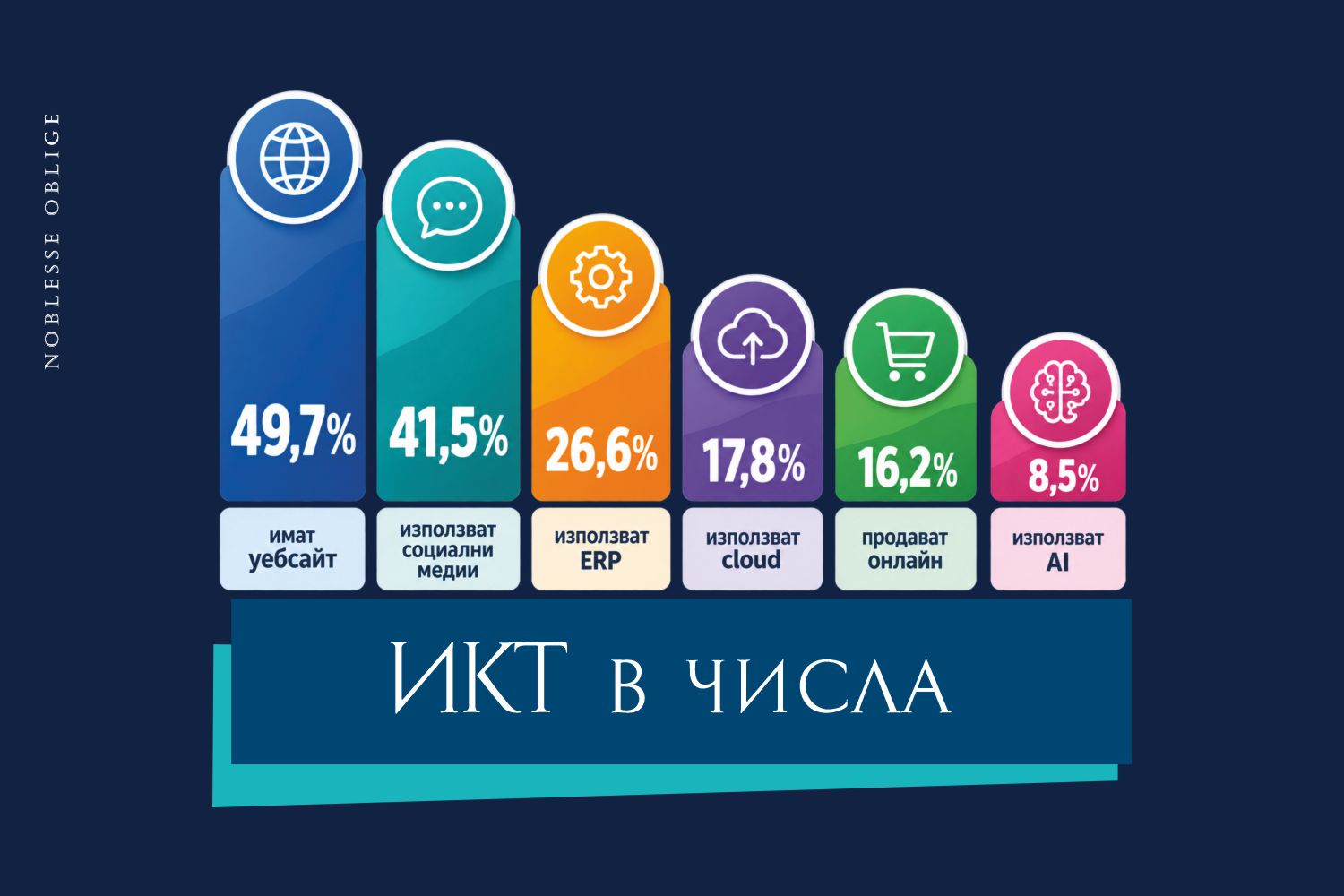
Digitalization of the Bulgarian economy
NSI data shows that digitalization is uneven : basic online presence has almost reached a plateau while new technologies grow; AI is accelerating but remains underdeveloped; and digitalization does not yet automatically translate into more innovation :
- Half of Bulgarian enterprises have a website , but the share is not growing : In 2025, 49.7% of enterprises have their own website, approximately the same as in 2018. This suggests that the digitalization of business is increasingly shifting beyond the basic online presence.
- Social media is gradually overtaking the traditional corporate website as a tool for digital presence . In 2025, 41.5% of businesses will use social media – almost 10 percentage points more than in 2016.
- Cloud technologies are entering gradually but steadily – the share of enterprises using paid cloud services is increasing from 8% in 2017 to 17.8% in 2025 – more than doubling.
- The share of enterprises using IoT technologies is increasing from 12.3% in 2020 to 15% in 2021, with large enterprises being almost twice as likely to use IoT as small ones – 26.3% versus 13.8%. Unfortunately, more recent NSI data is not available, but according to EIB Investment Survey 2024 32% of Bulgarian companies report using IoT , compared to 53% on average for the EU.
- Only 8.5% of Bulgarian enterprises use artificial intelligence technologies in 2025, but the trend is positive – the use of AI increased 2.6 times in 2025 compared to 2021, when the number of users of AI technologies was 3.3%. In other words, AI is rapidly entering, but it is still far from mass use.
- E-commerce is expanding, but not at the pace of AI and the cloud . In 2025, 16.2% of businesses will sell goods or services online, up from 10.9% in 2020.
- In 2025, ERP systems (enterprise resource management software) will be used by 26.6% of enterprises (up from 21.8% in 2021). After years of relative stagnation, the implementation of ERP systems is accelerating. At the same time, the use of CRM systems remains limited and even decreases - in 2025, CRM (customer relationship management software) will be used by 11.9% of enterprises, up from 16.9% in 2021.
- Eight out of ten enterprises implement cybersecurity measures – their share reaches 83.2% in 2024 – 1.3 percentage points more than in 2022. It is important to make the reservation here that “implement cybersecurity measures” does not mean “have a high level of cybersecurity”.
Digitalization is accelerating, but innovation performance does not automatically follow the same trajectory . After a peak of 11.8% in 2020 , the share of new products on the market falls by almost half to 6.1% in 2024. A worrying fact is that the share of innovation-active enterprises decreases from 36.2% in 2020 to 26.3% in 2024, which is a 9.9 percentage point or about 27% relative decline. At the same time, the share of innovation-active enterprises that collaborate with other organizations increases from 15.9% in 2018 to 25.4% in 2024.
Research and Development (R&D)
Bulgaria is investing more and more in R&D : EUR 805 million were invested in 2024 compared to EUR 524 million in 2020, which is a growth of 53.8%.
Who finances Bulgarian science? About 40% of R&D funding in Bulgaria comes from abroad , while the state budget provides about a quarter. Over a third of R&D investments come from enterprises:
|
Year |
State budget |
Enterprises |
Abroad |
Other national sources |
|
2020 |
25.3% |
35.4% |
38.8% |
0.5% |
|
2021 |
26.1% |
32.9% |
40.1% |
0.9% |
|
2022 |
24.6% |
34.7% |
40.0% |
0.7% |
|
2023 |
26.4% |
31.1% |
41.9% |
0.6% |
|
2024 |
26.8% |
32.3% |
40.3% |
0.6% |
Human resources
Digitalization is increasingly present in everyday work. The share of employees in enterprises using the internet is growing from 33.7% in 2020 to 44.8% in 2025 – an increase of 11.1 percentage points in five years.
Work is no longer necessarily tied to a physical office. The share of businesses providing remote access to their employees will reach 76.4% in 2024 – up 31.5 percentage points from 2015, when their share was 44.9%.
We are digitizing the workplace faster than we are developing people’s digital skills. The expansion of digital infrastructure and remote access has not been accompanied by the same growth in the provision of ICT training . In 2024, only 9.1% of enterprises provided such training – the same share as in 2022 and lower than the 10.1% reported in 2019.
ICT specialist recruitment. 41% of enterprises that have hired or tried to hire ICT specialists have had difficulty filling vacancies, compared to an EU average of 57.50% . This does not necessarily mean that the problem with ICT staff in Bulgaria is smaller, but rather that the share of enterprises that are actively looking for such specialists is lower – 8.96% of Bulgarian enterprises have hired or tried to hire ICT specialists, compared to 9.55% for the EU . In addition, 17.8% of Bulgarian enterprises have ICT specialists among their staff, compared to 20.1% on average for the EU.
The next challenge
Bulgarian businesses are gradually moving from a basic digital presence to using technologies that change the very way they work. The next challenge is to translate this technological transformation into more innovation and higher productivity.