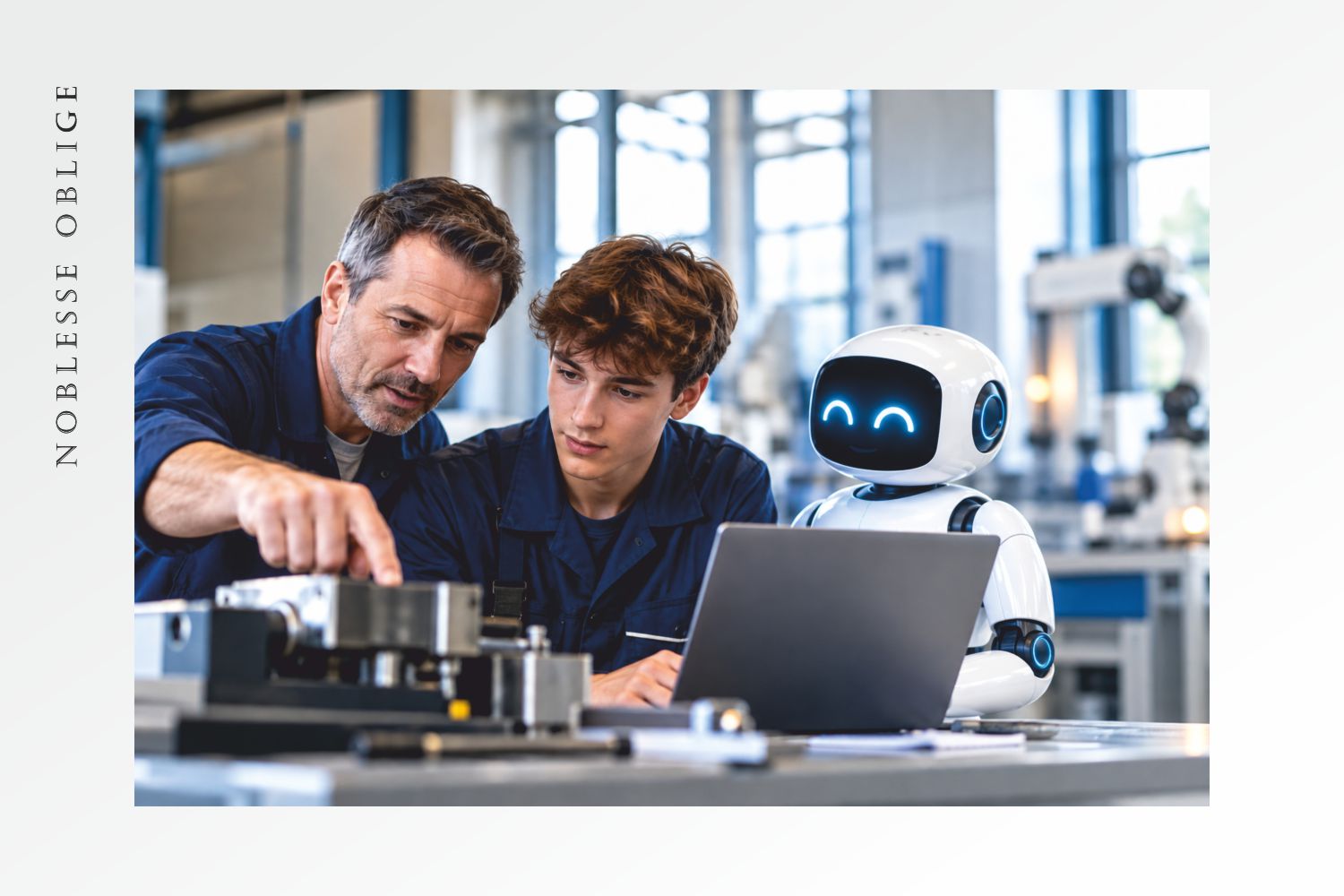
When a young person joins a company without enough practical experience, someone needs to show them how the job is actually done. Sometimes it's a student in a dual form of training, sometimes an intern, and sometimes a young employee starting their first job.
Usually, this task is taken on by a more experienced colleague. He knows the work process, typical mistakes, company requirements and those little things that are difficult to learn from instructions alone. That is why he is the most suitable person to introduce the new employee or intern, but he also has his own job. He needs to explain, show, check if the task is understood, monitor progress and give feedback. In longer training, preparing tasks, taking notes, planning the next steps and sometimes creating an assessment or report are added.
For many companies, this is precisely the difficulty. They are interested in training young people, but it requires time from employees who are already busy enough.
Artificial intelligence can help in this particular part of the work and save time. for various small tasks that are constantly repeated.
How to most effectively introduce AI into mentoring and dual training? This was the main question that the European project "Artificial Intelligence in Mentoring (AI in Mentoring)", coordinated by the Bulgarian Industrial Association over the past two years (from November 2024 to October 2026), attempted to answer.
The project involved people with different experiences. Some of them work with students in a dual form of training. Others train interns or introduce young employees who are starting their first job. Thus, the topic went beyond the narrower framework of vocational education and focused on a more general problem: how an experienced employee can train another person without it becoming an excessive additional burden.
During the trainings in Bulgaria, Belgium and Spain, participants tested various applications of AI in their own practice. Most often, it was about very everyday tasks – preparing materials, designing instructions, scheduling a meeting with the trainee, summarizing notes or preparing feedback.
As the training progressed, the questions became more specific. Instead of the general “What can AI do?” participants began to ask whether it could help them with a specific task, what information was reasonable to input, and how to verify the result.
Knowing many AI applications is not of much value in itself. It is useful when a specific tool solves a real problem in everyday work. For companies that train students, interns or new employees, this can mean less time on some of the preparatory tasks and more time on the actual introduction to the profession.
It could also be relevant for companies that have so far hesitated to engage in dual training or internship programs due to a shortage of people and time. AI will not eliminate this problem, but it can make the organization of training easier for the employees who undertake it.
The AI in Mentoring project's handbook for trainers and mentors includes practical examples and exercises for such use. It is aimed at people who train in the workplace and does not assume in-depth technical training.
How can AI help with training new employees and interns?
Sorting out the main steps and explanations with AI . An experienced specialist has to explain a work procedure to someone who has never performed it. For the specialist himself, it is obvious, but it is time-consuming to turn it into clear steps for a beginner. With AI, questions will also be sorted more quickly to check whether the young person has grasped the most important points.
AI-powered exercise preparation. The tutor describes a specific situation and gets ideas for tasks of varying difficulty. This is useful when learners are at different levels and the same instruction doesn't work equally well for everyone.
-powered note-taking and summarization. The mentor has been recording the intern’s performance, mistakes, and progress for several weeks. AI can help with this and follow-up.
AI feedback. Sometimes the mentor knows the problem well, but needs time to formulate it clearly and calmly. AI can offer a draft that can then be revised according to the specific person and situation.
AI doesn't automatically save time. If the employee doesn't know exactly what they want to achieve or has to spend a long time correcting an inaccurate result, the effect can be the opposite. It's important to start with the specific task, not the tool itself.
There is another important requirement for on-the-job training. Often, company information, personal data, or safety-related instructions are involved. Companies need to clearly define what information can be entered into AI tools, how the results are verified, and when the intervention of a person with professional experience is mandatory.
What is the mentor still needed for?
When some of the preparation becomes faster, time is freed up for what can hardly be transferred to technology.
The mentor sees how the young person acts in a real situation. He notices when he is unsure, when he is in too much of a hurry, when he repeats the same mistake, or when he is ready to take on more independence. He can show not only how to perform a task, but also how to react when something goes wrong.
This includes many things that are rarely described in official instructions. How do you communicate with colleagues? When should you ask for help? How do you take responsibility? What does a job well done look like in a particular company?
That is precisely the value of an experienced person.
If AI saves him some of the time preparing, writing, and organizing information, he can devote more attention to observing, talking, and working with the young person.
***
The project "Artificial Intelligence in Apprenticeship Mentoring" (No. 2024-1-BG01-KA220-VET-000247196) is implemented with the financial support of the Erasmus+ program of the European Union, coordinated by the Bulgarian Industrial Association. More information and materials on the project are available at: https://ai-mentoring.eu