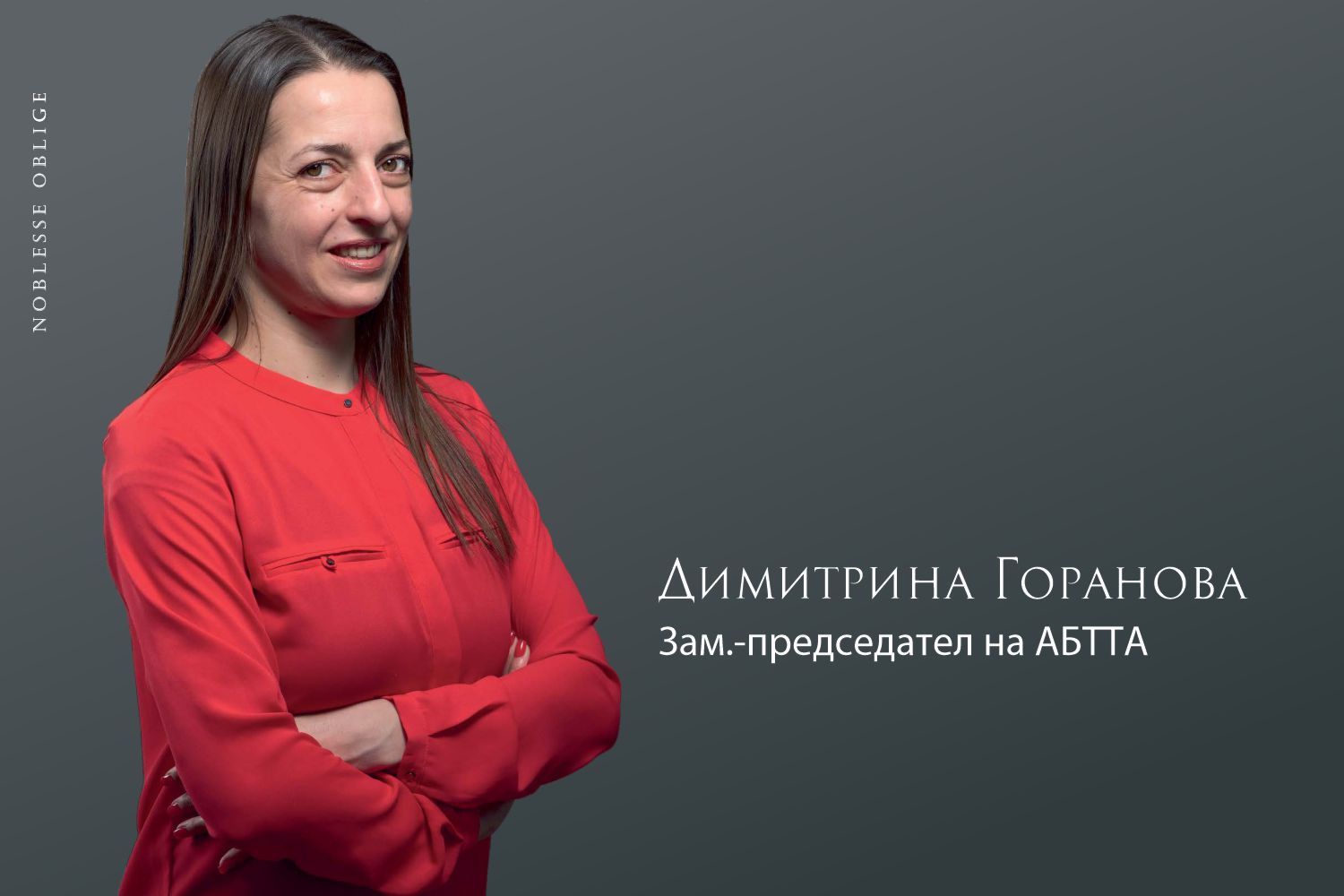
Dimitrina Goranova, Vice President of the Association of Bulgarian Tour Operators and Travel Agents (ABTTA)
Experts give different estimates of the share of tourism in the Bulgarian economy. How would you assess its real importance for the balance of payments, regional development and employment?
According to the latest data from the Ministry of Tourism, the sector generates over 8.5% of GDP. The tourism industry also has a strong multiplier effect on a number of other sectors – such as the food industry, trade and services. According to experts, this effect can lead to a fourfold increase in revenues for the local economy.
Therefore, we believe that the real contribution of tourism to GDP is significantly higher. For some regions in the country, it is also the main livelihood of the local population. In this sense, tourism also plays a significant role in demographic development - it helps to limit depopulation and migration to large cities.
According to NSI data, in 2025, the "Hotel and Restaurant" sector, which is the largest employer in tourism, will employ 102,646 people - about 4.5% of those working in Bulgaria. If we add to them those employed in travel agencies, transport companies, museums, attractions and other accompanying activities, their number will certainly double.
Even from the student bench, future experts learn that tourism is an "export on the spot." So why does Bulgaria still not have a clearly outlined and funded export strategy for it?
Tourism development should be a national priority, supported by a clear and long-term strategy. Unfortunately, this often remains at the level of declarations. In practice – with the exception of the Ministry of Tourism – the executive branch does not make sufficient efforts to develop the sector.
The budget of the Ministry of Tourism for 2025 is indicative – only 28.8 million leva – an amount that covers all the institution’s expenses. The increase compared to the previous year is only 1.7%, while the budgets of other ministries were increased several dozen times . For the current year, the funds are expected to remain approximately within the same limits.
In addition to the central government, the local government also plays an important role. More and more large municipalities are starting to work actively in this direction. A good example is the Sofia Municipality, which in 2025 took steps to more effectively use tourism revenues. With the consent of the business, the tourist tax was increased, and the funds will be used specifically to improve the city's tourism infrastructure.
In addition to the financial side of the problem, collaboration between institutions is also very important for the implementation of a successful strategy. At the national level, cooperation between the ministries of tourism and culture is key, because the development of the cultural tourism segment is extremely important for achieving sustainable year-round tourism, a more even distribution of tourist flows between seasons and destinations , and avoiding negative effects such as overtourism.
Naturally, coordination between central and local government is also essential. Perhaps the state should consider how to support and consult smaller municipalities that lack the knowledge and capacity, but have the tourism resources that are a basic prerequisite for tourism development.
The role of public-private partnerships is also essential. Business and administration must work together with clear goals. ABTTA actively participates in such initiatives – for example, through the annual forum “Meeting of Business with Local Authorities” and by assisting in finding funding for the digitalization of ticket sales for the Boyana Church.
Without contrasting mass tourism with specialized tourism, what should be the balance between the seasonal model and the year-round product with higher value?
Given the country's geographical location and climate change, if we want a sustainable and developing tourism sector, we cannot rely only on sea and ski tourism.
Summers are getting shorter – in recent years, hotels on the Black Sea coast have been fully booked mainly in July and August. Winters are warmer and with significantly less snow cover, despite the presence of artificial snow facilities.
This inevitably affects prices. For seasonal businesses to be profitable, they must compensate for the short active season with higher prices, so that two or three months of revenue covers the costs for the entire year.
How much do we use the potential of non-mass segments – cultural, SPA and wellness, wine, adventure tourism?
The short answer is – not enough, although the potential is huge.
Bulgaria has a rich resource for diversifying its tourism product. Therefore, it was a very positive signal that the Ministry of Tourism announced cultural tourism as one of the main priorities in the marketing strategy for 2026.
Modern trends show that the choice of a destination is increasingly determined not so much by the luxury hotel or the location itself, but by the experiences that the place offers. In this context, the combination of different tourism products – culture, gastronomy, SPA, wine tourism – can become a serious competitive advantage for Bulgaria.
Unfortunately, our country is still relatively little known as a SPA destination, despite the excellent natural conditions for the development of this segment.
With the decline of traditionally strong markets like Germany and the lack of Russia in recent years - where should we focus our efforts?
This issue is directly related to both the national budget for tourism advertising and the country's transport connectivity. For advertising to be effective, marketing activities must be targeted at key markets – and these continue to be European countries. I would add Turkey to these, where interest in Bulgaria as a ski destination is growing.
From a transport connectivity perspective, the situation remains challenging. Almost four years after the pandemic, aviation has still not fully restored its supply chains. There are serious delays in the production of new aircraft, which makes it difficult for airlines to plan new routes. At the same time, airfares continue to rise. According to our data, in 2025 they increased by over 30% compared to the previous year. With the introduction of biofuels and given the geopolitical situation, this trend is likely to continue. Therefore, I believe that the focus on European markets should remain leading.
If today we had to "reposition" Bulgaria on the world tourism map, which highlights would we retain?
In recent years, Bulgaria has no longer been perceived as a cheap destination, but rather as a "value for money" place. Progress has been made in this direction and we must continue to work.
However, we need to place greater emphasis on the quality of services, because that is where we lag behind some competing countries. This is something that we ourselves, as consumers of tourism services, clearly feel.
In addition to the traditional emphasis on sea and winter tourism, we need to more actively present the variety of products that the country offers - especially cultural and SPA tourism.
What is the role of tour operators in the transition to a higher value-added model?
It is decisive. Ultimately, it is the tour operators who turn ideas and concepts into real tourism products and packages.
It is likely that different models will exist in the future – tour operators that work primarily with mass tourists, as well as those that specialize in personalized trips and experiences.
Bulgaria is a destination that can offer both – and they are not mutually exclusive.