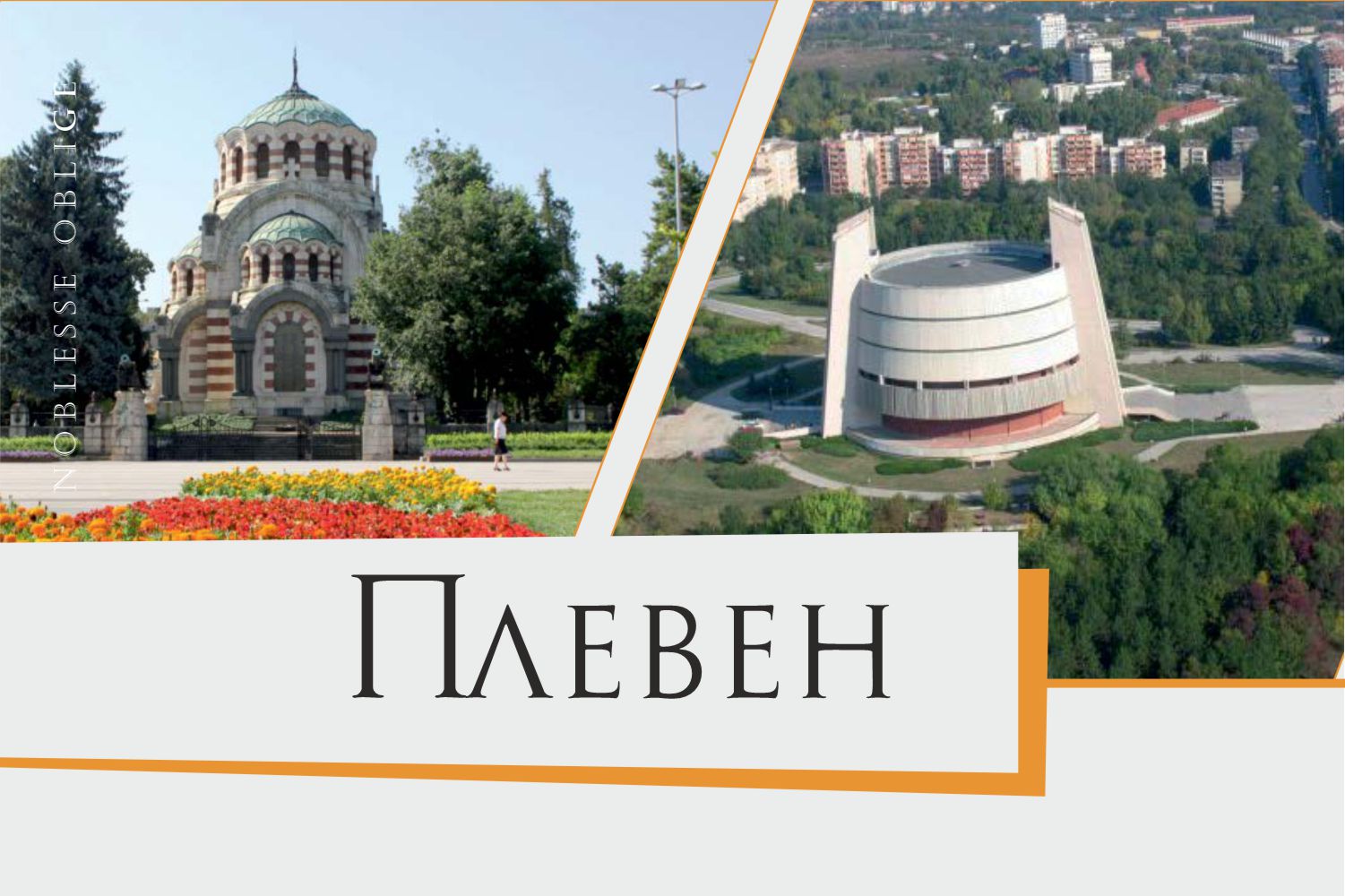
Pleven is the seventh largest city in Bulgaria. It is the administrative and economic center of Pleven District and Pleven Municipality, and is part of the Northwestern Economic Planning Region. Pleven Municipality is located in the heart of the Danube Plain in Northern Bulgaria, which determines its importance as an important administrative, economic, transport, gas distribution, political and cultural center.
The district includes 11 municipalities: Pleven, Belene, Gulyantsi, Dolna Mitropolia, Dolni Dabnik, Levski, Iskar, Nikopol, Pordim, Cherven Bryag, Knezha.
The gross domestic product, wages and pensions in the district are growing at a rate close to the national average, but remain relatively low. The poverty level is decreasing slightly, but remains above average. The share of the working-age population remains low. Investments in the district are declining, which is also affecting the value of the output.
The demographic picture is unfavorable. The performance on educational indicators is also poor.
NATURAL RESOURCES
A significant part of Pleven district is agricultural land, which is a major natural resource for the economy. The soils in the district are chernozem and alluvial , with high fertility - a factor for developed crop production (cereals, oilseeds, tobacco, vegetables). The flat relief and favorable climate make the land suitable for intensive agriculture. Favorable natural conditions support the breeding of farm animals, although the emphasis is stronger on crop production. Numerous rivers and streams pass through the district, which are used for irrigation and agricultural needs, as well as to maintain ecosystems. The presence of wetlands around rivers and along their banks is an important natural resource for biodiversity, fishing and soil-water balance.
In the Pleven region, there is a gas field near Deventsi , with proven reserves of natural gas (~235 billion cubic feet / about 6.6 billion cubic meters), which is being developed for energy use. In the wider region of the Danube Plain, there are deposits of refractory clays and other non-metallic minerals , which are used in construction and industry.
There are forest areas in Pleven District, but the district ranks last in terms of the share of forest areas in the country.
TRANSPORT AND INFRASTRUCTURE
Pleven is located on the first-class road E83 (Sofia-Varna) , which provides a major west-east connection. There is no motorway yet that directly passes through Pleven region; the future extension of the Hemus motorway (A2) will pass south of Pleven when completed. Road density is lower than the national average, and the quality of the pavements and the share of first-class roads are below the Bulgarian average.
The international railway line Sofia-Varna passes through Pleven , connecting it to major domestic and international centers. The railway network in the district is above the national average in density, which improves access to regional markets and the transportation of goods and passengers.
The Pleven region has access to waterways along the Danube River , with several small or medium-sized river ports (near Nikopol, Somovit, Zagrazhden and Baikal) . They provide potential for freight transport, but are of no national or international importance.
There is no active civil airport in Pleven region , but there is a project and efforts to restore a civil airport in Dolna Mitropolia (~10 km from Pleven), but at the moment it is not actively functioning as a civil airport . The nearest functioning airports are the airports in Sofia , Varna and Bucharest (Romania), which are within a few hundred kilometers.
Industrial Park Pleven is an example of modern industrial and logistics infrastructure, with electricity supply, telecommunications, gasification and potential for internal railway connection. The park's infrastructure attracts investments and supports production and logistics activities
HUMAN RESOURCES AND LABOR MARKET
According to the latest data from the National Statistical Institute, as of 31.12.2024, the population of Pleven district is 215,326 people, and the natural growth rate is strongly negative with a value of -11 ‰ (compared to –7.3‰ in the country). The district is also failing to attract population and the coefficient of mechanical growth is also negative (–0.1‰). There are high levels of population aging - the share of children under 4 years of age is 4.1%, and adults over 65 years of age is 28.2%. The share of the working-age population in Pleven district continues to decrease and remains relatively low - 55% compared to 55.5% in the country. The economic activity rate is higher than the national average - 77.2% compared to an average of 74%.
An improvement is observed in the educational structure of the workforce. The share of the population aged 25–64 with higher education increased to 30.7% (compared to 33.8% in the country), while the share of people with primary and lower education decreased to 15.4 (compared to 13.1% in the country).
Employment is increasing and unemployment is decreasing, but both indicators are less favorable than the average for the country. The employment rate reaches 70.5% (compared to 70.9% in the country), and the unemployment rate – 8.4% (compared to 4.2% in the country). 37% of jobs in the region are in the industry sector, 21% - in trade and services, 12% - in healthcare, with smaller shares being employed in agriculture and construction. The average annual salary of those employed under an employment contract in Pleven district in 2024 was 21,930 BGN (compared to 27,898 BGN for the country).
ECONOMY
Until 1989, Pleven was one of the highly developed industrial cities in Bulgaria, with the following sectors determining the structure: radio electronics, oil refining, metal casting and metalworking, mechanical engineering, chemical industry, construction, light and food industry. There were over ten institutes and development units attached to the enterprises and independently, such as NIPKI "Metal Technology" with about 1000 staff, NIPKTI for nuclear technology with over 300 people, BTR "Plastics Processing Machines" and others.
Immediately after 1989, enterprises and development units began to reduce the volume and areas of their work, attempts were made to convert and diversify production, but only a small part of the enterprises retained a small part of their production. Dozens of micro, small and medium-sized enterprises were created, mainly in the garment industry, services and construction, but also in some developed industries of the past, such as electrical engineering and electronics, security systems, mechanical engineering, building materials and elements.
Currently, among the larger enterprises operating in the region are: uroChem Agro – trade in chemical products; Kayser Automotive – German investor, produces components for the automotive industry; Industrial Park Pleven – industrial and logistics park with various tenants and manufacturing operations, a potential “hub” for export-oriented companies; Lebosol Bulgaria – a producer of liquid fertilizers and agrochemical products with a strong position in foreign markets.
Pleven was the center of a rich agricultural region. Plant production was predominant - cereals, perennial crops, technical crops and vegetables - tomatoes, and animal husbandry - cows, calves, pigs, poultry and, to a lesser extent, sheep. After 1990, animal husbandry gradually declined and today this industry is very limited. In the past, Pleven was an important wine-growing center and was surrounded on all sides by well-groomed vineyards. Today, many of the vineyard plots are abandoned.
The tourism sector in the district is poorly represented. The number of beds in accommodation facilities is 6 per thousand people (compared to 56 per thousand people in the country), and the number of overnight stays is 716 per thousand people (compared to 4,167 per thousand people). The number of overnight stays through online sharing economy platforms is also small.
EDUCATION
There are 103 schools in Pleven district, in which 23,341 students are educated. The representation of students from the district remains weak - the average success rate of the national external assessment in mathematics after the 7th grade is 36.3 points (compared to 42.9 points in the country). The success rate of the matriculation exam in Bulgarian language and literature is among the lowest in the country - "Good" 3.90 (compared to "Good" 4.30 in the country), and the share of poor grades is the highest - 17.8% (compared to 8.7% in the country). The correspondence between vocational education and the profile of the local economy is growing and is relatively high. Pleven is one of the districts with the lowest share of students and employees in the ICT sector. Higher education is represented on the territory of the district by the Medical University - Pleven, the Higher Air Force School in Dolna Mitropolia and the Pedagogical College at the University of Veliko Tarnovo.
HEALTH CARE
Pleven is a district with strong traditions in the field of healthcare and ranks first in this category. It is Pleven that is the district with the highest number of both general practitioners and specialist doctors. One local general practitioner takes care of an average of 1,197 people of the population (compared to 1,701 people per doctor in the country). The presence of a medical university in the city of Pleven is one of the prerequisites for the large number of doctors and the well-developed network of medical institutions in the district. Pleven is also the district with the highest number of hospital beds, which continues to increase and reaches the unprecedented 12.7 beds per thousand people of the population (compared to 6.1 beds per thousand people in the country). The utilization of beds is equal to the national average - 56%. The indicators for life expectancy in the area, the infant mortality rate and the number of pharmacies per population.